How to Invest in Mutual Funds in Pakistan: Step-by-Step Guide 2026
Learn how to open a mutual fund account in Pakistan, choose an account type, complete KYC, make your first investment and verify your units.
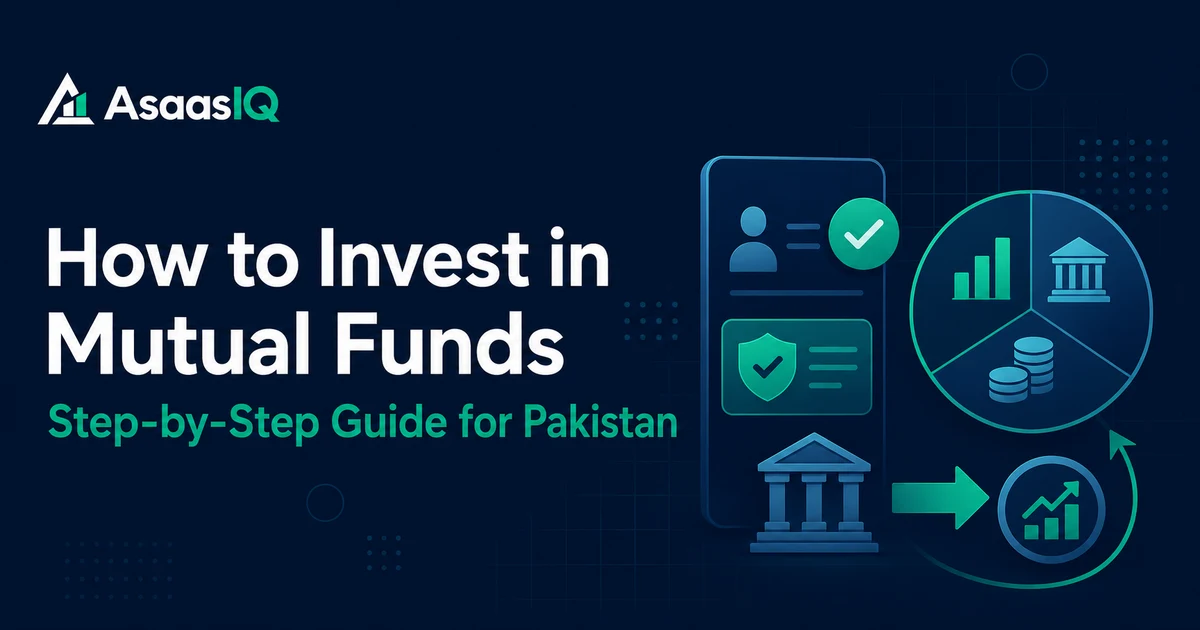
You do not need a stockbroker to buy units of an open-end mutual fund in Pakistan. In most cases, you open an investment account with a licensed asset management company (AMC) or through an authorised distribution platform, select a fund, transfer money from a verified account and receive units at the applicable price.
The process can often be completed online, but the important work starts before the application: deciding what the money is for and choosing a fund whose risk matches that goal.
Quick answer: To invest in a mutual fund in Pakistan, define your goal, select an SECP-licensed AMC, choose the correct account and fund category, complete KYC and risk profiling, transfer money through an approved channel, and verify the units in your statement. Minimum investments, documents, cut-off times, loads and redemption rules vary by AMC and fund.
This is an account-opening and first-purchase guide. For fund rankings and evaluation criteria, read Best Mutual Funds in Pakistan: How to Choose. For pricing mechanics, see How Mutual Fund NAV Works.
What are you actually buying?
An open-end mutual fund pools money from many investors. The AMC manages that pool according to the fund's offering document. When you invest, you receive units representing your share of the fund.
Your result depends on changes in the fund's net asset value (NAV), distributions where applicable, fees, taxes and the price used for your transaction. A mutual fund is not a bank deposit, and its return is not automatically guaranteed.
The AMC manages the fund, while other regulated parties—such as the trustee and custodian—perform separate oversight and safekeeping functions. Before opening an account, confirm that the AMC and fund appear in official SECP and MUFAP resources.
Step 1: Give the money a job
Write down three facts before comparing products:
- What is the money for?
- When might you need it?
- How much temporary loss could you tolerate without redeeming in panic?
A near-term bill, an emergency reserve and a retirement goal do not belong in the same risk category. A fund with higher long-term return potential may also have larger short-term losses.
If you do not yet have a cash buffer, start with Why You Should Build an Emergency Fund Before You Start Investing. If you are unsure how much volatility you can handle, use Understanding Risk Tolerance Before You Invest.
Step 2: Choose a fund category—not a recent winner
Select the category that fits the goal before selecting an individual fund.
| General need | Categories an investor may research | Main risk to understand |
|---|---|---|
| Short-term liquidity | Money-market or other lower-risk schemes | Returns can change; low risk is not zero risk |
| Income or medium-term goals | Income or suitable asset-allocation funds | Credit and interest-rate risk |
| Long-term growth | Equity or equity-heavy allocation funds | Large market declines and volatility |
| Shariah preference | Islamic variants within the relevant category | Screening, purification and category-specific market risk |
This table is educational, not a recommendation. Fund labels do not replace the offering document or the latest fund-manager report.
Do not choose an equity fund merely because it led a one-year performance table. Compare only within the same category and examine the benchmark, consistency, portfolio, risk and costs.
Step 3: Shortlist licensed AMCs and official platforms
An AMC should be licensed by the Securities and Exchange Commission of Pakistan. Use official sources rather than relying on a social-media advertisement or an app-store listing.
Check:
- The AMC's legal name and licence status.
- Whether the fund is listed in MUFAP's industry data.
- The official domain and verified mobile-app publisher.
- Customer support and complaint channels.
- The fund's offering document, key fact statement and latest report.
- Whether you are investing directly or through an authorised distributor.
Never transfer investment money to a salesperson's personal bank account. Use the payment route specified by the AMC or authorised platform and make sure the receiving details match the official instructions.
Step 4: Select the appropriate investment-account type
Pakistan's AMC onboarding framework provides different levels of account access. The exact option shown by an AMC can depend on the customer, channel and selected products.
Sehl Sarmayakari Account
The Sehl Account is designed for resident Pakistani individuals using simplified due diligence and is limited to eligible low-risk collective investment schemes. SECP allowed AMCs to open these accounts through their own digital platforms in January 2026.
Under the framework reported in May 2026, the cumulative investment limit was increased to PKR 1 million, with a PKR 300,000 transaction limit. Confirm current limits and eligible schemes in the AMC's latest documents before applying.
Sahulat Sarmayakari Account
The Sahulat Sarmayakari Account provides simplified onboarding with a higher limit. The 2026 framework raised its cumulative investment limit to PKR 3 million and its transaction limit to PKR 1 million. The earlier annual caps were removed.
This is a mutual-fund account. Do not confuse it with the PSX brokerage Sahulat Account covered in Sahulat Account vs Normal Account — different framework, different regulator interaction, same name.
Sarmayakari or regular account
A regular investment account uses fuller KYC and due-diligence requirements. It is generally relevant when the simplified-account limits or eligibility rules do not fit the investor.
An AMC may allow a simplified account to be upgraded after the customer supplies the additional information and documents.
Rules and implementation can change. Treat the limits above as last verified in August 2026, not as permanent product promises.
Step 5: Prepare your information and documents
Requirements vary by account type and investor profile, but an individual applicant may be asked for:
- CNIC or NICOP details.
- Mobile number and email address.
- A bank account or IBAN in the investor's own name.
- Occupation, employer or business information.
- Source of income and source of funds.
- Tax residency, FATCA and CRS declarations.
- Nominee or next-of-kin information where applicable.
- Zakat declaration where applicable.
- A specimen signature, selfie, biometric or liveness verification.
The process may be shorter when identity has already been verified through an eligible regulated financial institution and the systems are integrated under the applicable framework. However, an AMC can still request additional information when regulations or risk checks require it.
Use your own phone number, email and bank account. These details help protect withdrawals, statements and account recovery.
Step 6: Complete KYC and risk profiling honestly
Know Your Customer checks establish identity, tax status and source-of-funds information. Risk profiling asks about goals, time horizon, financial capacity, investment knowledge and response to losses.
Do not select the most aggressive answers simply to access a product. If an equity fund is inconsistent with your stated profile, that warning is useful.
Also check whether the AMC asks you to confirm:
- The account type.
- Conventional or Shariah-compliant preference.
- Dividend payout or reinvestment option, where available.
- Communication method and electronic statements.
- Bank mandate for investment and redemption proceeds.
Read each declaration before accepting it. Keep a copy of the submitted form and terms.
Step 7: Read the fund documents before placing the order
At minimum, review the latest:
- Key fact statement or fund factsheet.
- Offering document.
- Fund-manager report.
- Expense ratio and sales-load information.
- Risk profile and benchmark.
- Asset allocation and major holdings.
- Dealing days, cut-off time and redemption timeline.
The offering document is the legal foundation; the factsheet is a shorter snapshot. Marketing return figures should not be read without the period, calculation basis and benchmark.
If you need help interpreting price and unit calculations, read How Mutual Fund NAV Works. For costs, use Understanding Mutual Fund Fees and Expense Ratios.
Step 8: Make the first investment through an approved channel
Follow the AMC's instructions. Common routes may include bank transfer, direct debit, payment gateway, cheque or an integrated banking channel.
Before sending money, verify:
- The payee and account details are official.
- The payment comes from an allowed account in your name.
- Your investor or folio reference is correct.
- The selected fund and amount are correct.
- You understand the transaction cut-off time.
- You know whether a front-end load or other charge applies.
The minimum initial investment is not universal. Some products accept relatively small amounts, while others require more. Use the current key fact statement or AMC application screen instead of relying on an old blog post.
Step 9: Understand which NAV will apply
Sending money at a displayed NAV does not always mean you receive that exact NAV. Open-end funds may use forward pricing, and the applicable price can depend on when a complete request and cleared funds are received relative to the cut-off.
A simplified illustration:
Net amount applied = investment amount − applicable front-end charge
Units received = net amount applied ÷ applicable offer price per unit
The exact calculation can include the fund's pricing structure and statutory charges. Confirm it on the transaction advice rather than estimating from a website snapshot.
Step 10: Verify the transaction and your units
After processing, look for an official transaction confirmation or account statement showing:
- Fund name.
- Transaction date.
- Gross investment.
- Applicable price or NAV.
- Loads, taxes or other deductions.
- Number of units allocated.
- Closing unit balance.
- Folio or account reference.
If the figures do not match your instructions, contact the AMC promptly through its official support channel.
Do not judge success by whether the NAV rises the next day. The first objective is to confirm that the account, product and transaction are correct.
Step 11: Set up a repeatable investment process
If the investment supports a recurring goal, consider automating an affordable monthly amount. Automation can improve consistency, but it does not eliminate market risk or guarantee a better result than a lump sum.
Use the Monthly Investment Calculator to test contribution amounts and assumed return scenarios. Then read Lump Sum vs Monthly Investing for the trade-offs.
Review the plan periodically—not every hour. Useful review events include:
- A change in the goal or deadline.
- A change in income or emergency savings.
- A material change in the fund's objective, risk, fee or manager.
- Persistent benchmark-relative weakness that requires investigation.
- A portfolio allocation that has moved far from your intended level.
How do redemptions work?
You submit a redemption request through the AMC or authorised platform. The fund processes it under its dealing and cut-off rules, deducts applicable taxes or charges and sends proceeds to the registered bank account.
Before investing, learn:
- The expected redemption timeline.
- Whether a back-end load applies.
- The tax treatment of capital gains or distributions.
- Whether exceptional circumstances can delay dealing.
- How partial and full redemptions affect the account.
Liquidity does not mean instant cash in every situation. Do not place money needed tomorrow into a product without checking the actual withdrawal process.
Common first-time mistakes
Choosing by one-year return
This often means buying after a strong period without understanding the risk taken to produce it.
Confusing the AMC with the fund
One AMC can offer funds with very different objectives. Evaluate the specific scheme, not just the company brand.
Ignoring the cut-off time
A late or incomplete request can receive a later price than expected.
Sending money through an unofficial route
Never use personal accounts, informal agents or unverified links.
Treating lower risk as guaranteed
Even a low-risk mutual fund is an investment product. Read its stated risks and latest portfolio.
Opening several overlapping funds
Owning multiple funds does not automatically create diversification. They may hold similar securities or serve the same purpose.
First-investment checklist
- I have a specific goal and time horizon.
- I selected the fund category before the fund name.
- I verified the AMC through official sources.
- I chose the right account type and understand its limits.
- I completed KYC and risk profiling accurately.
- I read the latest factsheet, offering document and fee information.
- I verified the official payment route and cut-off time.
- I saved the transaction confirmation and checked my units.
- I know how redemptions, taxes and complaints work.
Frequently asked questions
Can I invest in mutual funds online in Pakistan?
Yes. Many AMCs and authorised platforms support digital onboarding and transactions. Availability and verification steps depend on the investor and account type.
Do I need a PSX brokerage account?
Not for buying units of a typical open-end mutual fund directly from an AMC or authorised distributor. Exchange-traded funds are bought on the stock exchange through a brokerage account and work differently.
What is the minimum investment in a Pakistani mutual fund?
There is no single industry-wide minimum. It varies by AMC, fund and transaction type. Check the product's current key fact statement or official application page.
Can I lose money in a mutual fund?
Yes. The level and type of risk depend on the fund's portfolio. Equity funds can fluctuate substantially; lower-risk funds can also face market, credit, liquidity or operational risks.
Can I invest in an Islamic mutual fund?
Yes. Pakistan has Shariah-compliant funds across multiple categories. Read Islamic Mutual Funds vs Conventional Funds in Pakistan and What Makes an Investment Shariah-Compliant in Pakistan? for the concepts you should verify.
How can I compare funds before investing?
Compare funds within the same category using risk, benchmark-relative results, fees, portfolio quality, consistency and liquidity. Best Mutual Funds in Pakistan: How to Choose walks through that comparison checklist step by step, but it does not replace official fund documents.
Final takeaway
Opening a mutual fund account is increasingly straightforward. Choosing an appropriate fund still requires care.
Start with the goal, verify the provider, select the correct account and category, understand the documents and costs, use only official payment channels, and check the units after every transaction. A clean process is more valuable than rushing into the fund with the most eye-catching recent return.
Sources & References
Educational information only
AsaasIQ provides general educational content about investing in Pakistan. Nothing on this site is personalized financial, tax, legal or investment advice. AsaasIQ is not a financial advisor, broker, asset management company or affiliate of the Pakistan Stock Exchange. Always verify current facts, rates and regulations with official sources before acting.

Founder and Editor, AsaasIQ
Software engineer and the founder of AsaasIQ. Not a licensed financial adviser -- every article is educational and source-linked.
Published August 2026 · Last reviewed August 2026