Best Mutual Funds in Pakistan: How to Choose in 2026
Learn how to compare mutual funds in Pakistan by category, risk, returns, fees, benchmark and liquidity—without chasing last year's winner.
Searching for the best mutual funds in Pakistan usually produces a list of recent winners. That can be useful for discovering funds, but it does not answer the more important question: which fund is appropriate for your goal, time horizon and ability to handle losses?
A money-market fund and an equity fund do different jobs. Comparing them only by their latest return is like choosing between an umbrella and a bicycle because one cost more last year.
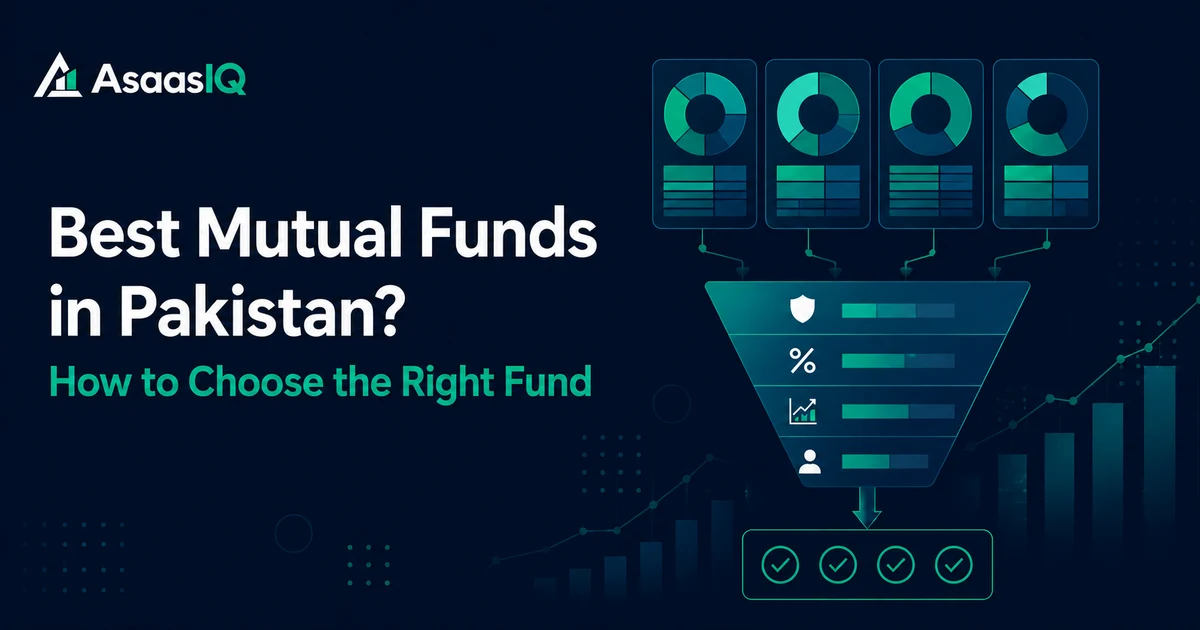
Quick answer: There is no single best mutual fund for every investor. Start by choosing the correct fund category for your goal. Then compare funds within that category using risk, benchmark-relative performance, consistency, fees, portfolio quality, liquidity and service—not one-year return alone.
This guide provides a practical framework for comparing mutual funds in Pakistan without turning an educational article into a list of short-lived recommendations.
What does "best mutual fund" actually mean?
The word best can describe several different things:
- Highest recent return.
- Lowest volatility.
- Fastest access to cash.
- Lowest fees.
- Strongest long-term performance relative to a benchmark.
- Shariah-compliant investment process.
- Most convenient digital service.
- Best match for a particular financial goal.
A fund can be strong in one area and unsuitable in another. An equity fund may generate substantial long-term growth but experience severe declines. A money-market fund may fluctuate less and provide easier liquidity, but it is unlikely to deliver the same long-term growth potential as equities.
The right question is therefore:
Which fund has an appropriate objective and risk profile for the job I need it to perform?
Step 1: Define your goal before comparing funds
Start with the purpose of the money.
| Goal | Possible time horizon | What usually matters most |
|---|---|---|
| Emergency reserve | Immediate access | Liquidity and capital stability |
| Planned expense | Under 1–3 years | Lower volatility and predictable access |
| House or education fund | 3–7 years | Balance between stability and growth |
| Retirement or long-term wealth | 7+ years | Growth, diversification and cost control |
| Regular income | Varies | Distribution policy, risk and sustainability |
These are educational examples rather than fund recommendations. Your ability to take risk also depends on income stability, an emergency fund you can draw on before touching investments, debt and whether you can postpone the goal.
If you need the money next month, a strong ten-year equity return will not protect you from a market decline next week. And regardless of category, how you get the money in matters too — see Lump Sum vs Monthly Investing if you're deciding between investing a windfall at once or building the position gradually.
Step 2: Choose the correct mutual-fund category
Pakistan offers conventional and Shariah-compliant variations across several fund categories. Exact portfolio rules vary, so always read the offering document and latest fund-manager report.
Money-market funds
Money-market funds generally invest in shorter-term instruments and are commonly considered lower-risk relative to equity funds. Investors often examine them for liquidity management or shorter goals.
Lower risk does not mean zero risk or a guaranteed return. Returns can change when interest rates and market conditions change.
Income funds
Income funds invest in debt and money-market instruments with the aim of generating income. Their risk can depend on duration, interest-rate sensitivity, credit quality and the specific securities held.
Do not assume every income fund carries the same risk. Examine the fund's stated risk profile, credit-quality exposure and asset allocation.
Equity funds
Equity funds invest primarily in shares and can experience significant short-term gains or losses. They are generally more relevant to investors with longer horizons and sufficient capacity to tolerate volatility, and their behavior has more in common with direct PSX investing than with a savings product.
Compare an equity fund with other funds in the same category and with its stated benchmark—not with a money-market fund.
Asset-allocation, balanced and fund-of-funds products
These products combine asset classes or invest through other funds. Their value lies in managed allocation, but the investor should still examine the underlying exposure, total cost and whether the allocation actually matches the goal.
Shariah-compliant funds
Islamic funds invest according to their approved Shariah framework and may be available across money-market, income, equity, asset-allocation and other categories. Review the Shariah adviser, screening methodology and purification disclosures where relevant.
For a detailed structural comparison, read Islamic Mutual Funds vs Conventional Funds in Pakistan on AsaasIQ.
Step 3: Match the fund's risk profile to your own
The Securities and Exchange Commission of Pakistan distinguishes between an investor's ability to take risk and willingness to take risk.
- Ability means whether your finances can absorb a loss or delay.
- Willingness means whether you can emotionally tolerate fluctuations.
- Need means whether taking additional risk is necessary to reach the goal.
Someone may be emotionally comfortable with risk but financially unable to delay a near-term payment. Another investor may have a long horizon and stable income but still lose sleep when the portfolio declines.
Consider:
- When will you need the money?
- How large a temporary decline could you tolerate?
- Would a decline force you to redeem?
- Do you have emergency savings?
- Is your income stable?
- How much of your total wealth would be placed in this fund?
Start with understanding your risk tolerance before comparing specific funds — it's a starting point, not personalised financial advice.
Step 4: Compare returns properly
Past performance is useful evidence, but it is not a promise.
Compare like with like
Compare funds within the same category and over the same period. A money-market fund should not be criticised for failing to match an equity rally; it was designed for a different purpose.
Review multiple periods
Do not rely on one-year returns. Examine:
- Month-to-date and year-to-date figures for context.
- One-year performance.
- Three-year and five-year performance where available.
- Performance during both rising and falling markets.
- Since-inception performance, while considering the launch date.
Compare with the benchmark
A fund's return becomes more meaningful when compared with its stated benchmark. Ask whether it added value after costs and whether that result was consistent.
Look for consistency, not one lucky year
The fund ranked first this year may have taken greater risk or benefited from a narrow market move. Examine whether performance persists across periods and market conditions.
Check the calculation basis
Confirm whether published figures are annualised or absolute and whether distributions are included. Comparing unlike return calculations can create a false conclusion.
The MUFAP performance summary provides category and return information that can be used as a starting point. Verify important numbers through the fund's official report before acting.
Step 5: Measure risk, not just return
Two funds can produce the same return with very different journeys.
Useful questions include:
- How much did the fund decline during difficult periods?
- How volatile have its returns been?
- Is performance dependent on a few concentrated holdings?
- Does the portfolio contain lower-quality debt?
- How sensitive is it to interest-rate changes?
- Is the fund taking more risk than its category suggests?
Advanced comparison tools may show standard deviation, Sharpe ratio or downside measures. These can help, but they should not replace understanding the portfolio.
A higher Sharpe ratio generally indicates more return per unit of measured volatility, but it is still based on historical data and assumptions.
Step 6: Understand fees and loads
Fees reduce the return that remains for the investor. Review:
- Total expense ratio.
- Management fee.
- Front-end load when purchasing units.
- Back-end or contingent load when redeeming.
- Government levies included in reported expenses.
- Fees charged through any distributor or platform.
An expense ratio is usually reflected in the fund's NAV rather than appearing as a separate monthly bill. A small annual difference can compound into a meaningful amount over many years — see Understanding Mutual Fund Fees and Expense Ratios for how that compounding effect actually plays out, and try the Compound Growth Calculator to see the gap a lower or higher expense ratio makes over a long holding period.
However, the lowest-fee fund is not automatically the best. Compare cost alongside risk, benchmark performance, service and investment process.
Step 7: Read the fund-manager report
A fund-manager report can reveal more than a performance table.
Look for:
- Asset allocation.
- Largest holdings.
- Sector concentration.
- Cash position.
- Credit-quality breakdown for debt portfolios.
- Duration or maturity information where relevant.
- Fund size or assets under management.
- Benchmark.
- Risk profile.
- Expense ratio.
- Manager commentary.
- Shariah disclosures for Islamic funds.
If the portfolio looks substantially different from what the category name led you to expect, investigate before investing.
Step 8: Evaluate liquidity and operations
A fund can look attractive on paper but still be inconvenient for your needs.
Check:
- Dealing days.
- Transaction cutoff time.
- When the applicable NAV is determined.
- Expected redemption processing time.
- Minimum initial and subsequent investment.
- Available payment methods.
- Quality of transaction confirmations and statements.
- Mobile and web access.
- Customer-support responsiveness.
- Whether systematic monthly contributions are supported.
Do not assume that pressing "redeem" immediately fixes the amount shown on screen. The applicable NAV, cutoff rules, taxes and loads can affect the final proceeds — how mutual fund NAV works explains the mechanics behind that timing.
A practical mutual-fund comparison checklist
Before choosing between two funds, compare them in this order:
- Are they in the same category?
- Does the category match the goal and time horizon?
- What risk profile does each fund disclose?
- How have they performed against the same benchmark and peers?
- Were returns consistent across several periods?
- What are the expense ratio and applicable loads?
- What does each fund actually hold?
- Are there concentration or credit-quality concerns?
- How quickly can units be redeemed?
- Does the conventional or Shariah structure match your preference?
Run through this list every time — it's a deliberate speed bump against picking a fund off a "top 10" headline alone.
Worked example: choosing by goal instead of ranking
Imagine two investors each have PKR 500,000.
Investor A
Investor A may need the money for university fees in six months. A recent equity winner could expose that payment to a major short-term decline. Liquidity and stability are more important than chasing the highest trailing return.
Investor B
Investor B has emergency savings, stable income and a ten-year horizon. This investor may be able to evaluate equity or allocation funds and tolerate greater volatility in pursuit of long-term growth.
The "best" fund is different because the job is different—even though the starting amount is identical.
Red flags when researching mutual funds
Be cautious when you see:
- Guaranteed-return language for a market-linked product.
- A ranking with no date or category.
- Returns shown without identifying whether they are annualised.
- No discussion of risk, benchmark or fees.
- Pressure to invest immediately.
- A payment request to an individual's personal account.
- Unclear information about the AMC, trustee or regulatory status.
- Social-media screenshots used instead of official reports.
Always verify the product and asset-management company through official sources. MUFAP fund profiles may include risk, benchmark, fees, returns and portfolio information, while the AMC's own offering documents and reports provide product-specific details.
Frequently asked questions
Which mutual fund gives the highest return in Pakistan?
The answer changes with the date and measurement period. The highest recent return may also involve greater risk. Compare funds within the same category and examine benchmark-relative performance, fees and consistency rather than treating the latest winner as a permanent recommendation.
Which mutual fund is best for beginners in Pakistan?
There is no universal beginner fund. A beginner should first identify the goal, time horizon, liquidity requirement and capacity for loss. Understanding a simpler, lower-volatility category may be easier, but suitability depends on the individual's circumstances.
Are money-market funds risk-free?
No. They are generally considered lower-risk than equity funds, but lower risk does not mean no risk or a guaranteed return. Review the fund's portfolio, risk profile and offering documents.
How much money is needed to invest in a mutual fund?
Minimum investments vary by AMC and fund. Check the latest official product information rather than relying on a general figure.
Should I choose a fund based on its NAV?
No. A lower NAV does not mean a fund is cheaper or has greater upside. NAV represents the per-unit value of the portfolio after liabilities. Compare investment strategy, risk, return and cost instead.
Can I lose money in a mutual fund?
Yes. Mutual-fund values and returns can change, and some categories can experience substantial losses. Diversification can reduce certain risks but cannot eliminate market risk.
Are Islamic mutual funds available in lower-risk categories?
Yes, Shariah-compliant funds can exist across multiple categories, not only equities. Review the category, portfolio and Shariah disclosures of the specific fund.
Final thoughts
The best mutual funds in Pakistan are not identified by a permanent top-ten list. A strong selection process starts with the investor's goal and then compares appropriate funds by category, risk, benchmark-relative performance, consistency, fees, holdings and liquidity.
Use rankings to discover candidates—not to outsource the decision. Verify current information through MUFAP, the AMC and regulatory sources before investing.
Sources & References
Educational information only
AsaasIQ provides general educational content about investing in Pakistan. Nothing on this site is personalized financial, tax, legal or investment advice. AsaasIQ is not a financial advisor, broker, asset management company or affiliate of the Pakistan Stock Exchange. Always verify current facts, rates and regulations with official sources before acting.

Founder and Editor, AsaasIQ
Software engineer and the founder of AsaasIQ. Not a licensed financial adviser -- every article is educational and source-linked.
Published August 2026 · Last reviewed August 2026