Understanding Risk Tolerance Before You Invest
What risk tolerance actually means, how it differs from risk capacity, and why understanding both matters before choosing where to invest in Pakistan.
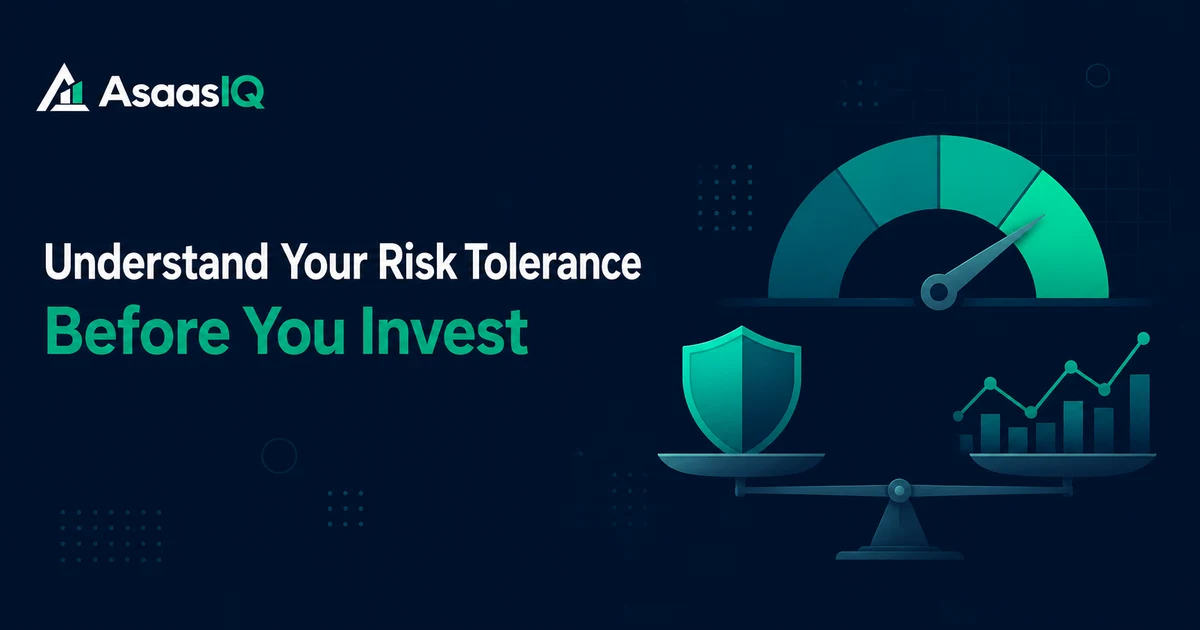
"What's your risk tolerance?" is one of those questions that sounds like it should have an easy answer, right up until you actually try to answer it. Most people default to "medium," mostly because it feels like the safe, non-committal choice. But risk tolerance isn't really a single number you pick off a scale — it's closer to an honest self-assessment that most people, understandably, haven't done much thinking about before someone asks them directly.
Getting this wrong in either direction causes real problems. Underestimate your comfort with risk, and you might end up in overly conservative investments that don't grow enough to meet your actual goals. Overestimate it, and you risk panic-selling during a downturn — locking in losses at exactly the wrong moment, right when patience would have paid off.
Two different questions people often mix up
A useful distinction that gets skipped in a lot of casual advice: risk tolerance and risk capacity are not the same thing, even though they get used interchangeably all the time.
Risk tolerance is psychological — how much market volatility can you actually stomach without losing sleep, making panicked decisions, or abandoning your plan? This is about temperament, not math.
Risk capacity is financial — given your actual income, expenses, time horizon, and obligations (including whether you already have an emergency fund in place), how much risk can you afford to take, regardless of how you feel about it? This is about math, not temperament.
These two can genuinely conflict. Someone might have high risk capacity — stable income, long time horizon, no dependents relying on the money — but low risk tolerance, meaning market drops genuinely stress them out even though they can objectively afford to ride them out. The reverse happens too: someone with limited risk capacity (short time horizon, relies on the money soon) might feel personally comfortable with volatility but simply can't afford the downside if it materializes at the wrong time.
When these two disagree, capacity should generally set the outer boundary, and tolerance should determine where you sit within it. In other words: don't take on more risk than you can actually afford, even if you feel emotionally fine with it — feelings can be wrong about future reactions to an actual loss you haven't experienced yet.
Why self-assessment is genuinely hard
Most people have never actually watched a meaningful chunk of their real money drop 20% in a bad month. It's easy to say "I'd be fine with that" in the abstract, sitting comfortably with no money at risk. It's a different experience entirely when it's happening to money you worked for and can see the number falling in real time.
This is why risk tolerance assessments — the kind with a series of scenario-based questions — tend to be more useful than just asking someone to rate their tolerance on a 1-to-10 scale. Concrete scenarios ("if your investment dropped 20% in a month, would you sell, hold, or buy more?") force a more honest answer than an abstract self-rating, because they make you actually picture the situation rather than describe your aspirational self-image.
A few honest questions worth sitting with:
- If your portfolio dropped 15-20% over a few months, would you check it constantly, or would you be able to leave it alone?
- Have you ever actually experienced a significant investment loss before, or is your sense of your own tolerance untested?
- Would a market downturn affect your day-to-day decisions or stress levels, or would it stay abstract and distant?
There's no scoring system here — the point is building genuine self-awareness, not producing a number.
Time horizon changes what's reasonable
Risk tolerance doesn't exist in a vacuum — it interacts heavily with how soon you'll actually need the money. Money you won't touch for fifteen or twenty years can typically absorb more short-term volatility, because there's time for markets to recover from a downturn before you need to withdraw. Money you'll need in a year or two generally shouldn't be exposed to the same volatility, regardless of how comfortable you feel with risk in the abstract — a downturn right before you need the money doesn't have time to recover.
This is part of why a blanket "how much risk should I take" question doesn't have one answer even for the same person — it depends on which specific goal and time horizon you're asking about. Retirement savings decades away and a house down payment you're targeting for next year reasonably call for very different risk postures, even for the same investor.
How this connects to actual investment choices
Risk tolerance and capacity, once you've thought them through honestly, should inform practical decisions — how much of your portfolio sits in more volatile assets like individual stocks or equity funds versus more stable options like money market funds or savings instruments, and how you'd realistically react to a downturn rather than how you'd like to imagine reacting.
If you're investing through calculators like AsaasIQ's Monthly Investment Calculator, which lets you compare conservative, moderate, and growth return scenarios, your honest risk assessment is part of what should inform which scenario actually reflects your plan — not just which one produces the most attractive projected number, since a higher assumed return typically comes paired with higher volatility along the way, not just a bigger number at the end.
What this article can't do for you
Risk tolerance is genuinely personal, and no general article — including this one — can assess it for you accurately. What we can do is give you a better framework for thinking it through honestly. If you want a more structured, personalized risk assessment, or help translating your risk tolerance into an actual investment allocation, a licensed financial advisor is far better positioned to guide that conversation than a self-assessment checklist on a website.
Sources & References
Educational information only
AsaasIQ provides general educational content about investing in Pakistan. Nothing on this site is personalized financial, tax, legal or investment advice. AsaasIQ is not a financial advisor, broker, asset management company or affiliate of the Pakistan Stock Exchange. Always verify current facts, rates and regulations with official sources before acting.

Founder and Editor, AsaasIQ
Software engineer and the founder of AsaasIQ. Not a licensed financial adviser -- every article is educational and source-linked.
Published August 2026 · Last reviewed August 2026