50/30/20 Budget Calculator: Needs, Wants and Savings
Split your take-home income into needs, wants and savings with a flexible 50/30/20 budget calculator. Compare targets with actual monthly spending.
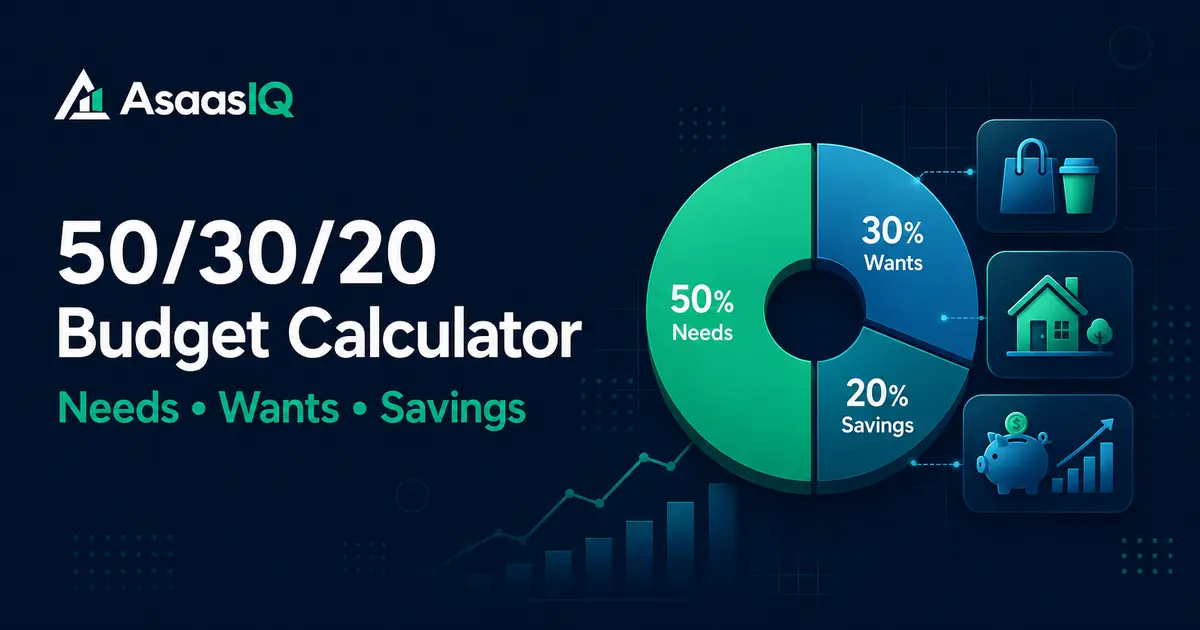
The 50/30/20 budgeting guideline divides monthly take-home income into three broad buckets:
- 50% for needs.
- 30% for wants.
- 20% for savings and extra debt repayment.
If take-home income is 4,000 per month, the starting targets are 2,000 for needs, 1,200 for wants and 800 for savings or additional debt repayment.
Formula:
Needs = income × 50%,Wants = income × 30%,Savings/debt = income × 20%
The split is a planning guideline, not a financial law. Housing costs, income, dependants, benefits, debt and local conditions can justify a different allocation.
How to use the 50/30/20 rule
Start with monthly take-home income, then work out target amounts for:
- Needs.
- Wants.
- Savings and extra debt repayment.
For a more useful result, compare those targets against actual monthly expenses under each category:
- Target versus actual amount.
- Actual percentage of income.
- Amount above or below each guideline.
- Total allocated and unallocated income.
- Monthly and annual views.
- A custom split such as 60/20/20.
Quick example
Monthly take-home income: 4,000

Needs:              4,000 × 0.50 = 2,000
Wants:              4,000 × 0.30 = 1,200
Savings/extra debt: 4,000 × 0.20 =   800
The same calculation works in any currency because only the proportions matter.
What is the 50/30/20 rule?
The 50/30/20 rule is a simple budgeting framework that groups spending and saving into three categories rather than tracking dozens of limits.
The US Consumer Financial Protection Bureau uses the framework in financial-education material and describes budgeting as a way to provide for needs and wants while building savings for future goals.
The guideline is best understood as:
- Keep needs near or below 50% when reasonably possible.
- Allow up to 30% for wants rather than treating it as an amount that must be spent.
- Direct around 20% toward savings, investing and debt repayment beyond required minimums.
The percentages are a starting point for discussion. They do not account for every household, country or stage of life.
Which income should you use?
Use after-tax or take-home income: the amount available after compulsory income tax and similar deductions.
If paid monthly, use monthly take-home income directly. If paid weekly or every two weeks, convert to an average month:
Weekly income × 52 ÷ 12
Biweekly income × 26 ÷ 12
If income is 48,000 annually after tax:
48,000 ÷ 12 = 4,000 average monthly income
Avoid using one unusually high month when income varies. A cautious rolling average or base-income amount may produce a more sustainable budget.
Handling payroll deductions
Take-home pay may already exclude retirement contributions, insurance or other benefits. Choose one consistent method.
Method 1: Budget the bank deposit
Use the amount reaching your bank and do not count payroll deductions again. This is simple but hides savings or benefits paid before the deposit.
Method 2: Reconstruct allocable after-tax income
Add voluntary payroll savings back to take-home income, then record them in the savings bucket.
Example:
Bank deposit:                    3,700
Retirement contribution:          300
Allocable after-tax income:     4,000
Savings already completed:        300
Do not add a contribution to income and then forget to count it as saving. That would overstate unallocated money.
Compulsory pension, tax and social-insurance systems vary by country. Label assumptions instead of forcing one universal treatment.
What belongs in needs?
Needs are expenses required for basic living, work, health, safety or contractual minimum obligations.
Common examples:
- Basic housing payment.
- Essential utilities.
- Groceries and basic household supplies.
- Necessary transport.
- Essential insurance.
- Healthcare and medication.
- Childcare required for work.
- Minimum required debt payments.
- Basic education or work costs.
The word "basic" matters. A need can contain a discretionary upgrade. Transportation may be necessary, but the difference between a reliable modest vehicle and a luxury vehicle can be a want.
What belongs in wants?
Wants improve comfort or enjoyment but can normally be reduced, postponed or replaced.
Examples include:
- Restaurant meals and takeaway.
- Entertainment and gaming.
- Nonessential subscriptions.
- Leisure travel.
- Hobbies.
- Fashion beyond basic clothing.
- Premium upgrades.
- Frequent device replacements.
- Convenience services.
A category can differ between households. High-speed internet may be a need for remote work but an upgraded entertainment package may be a want.
The 30% figure is not a spending target. If wants use only 15%, the remaining amount can strengthen savings or another priority.
What belongs in the 20% savings and debt bucket?
This category builds future financial capacity.
It can include:
- Emergency-fund contributions.
- Retirement savings.
- Long-term investments.
- Education or home-deposit savings.
- Other financial goals.
- Debt payments above the required minimum.
Minimum required debt payments usually belong in needs because they are current obligations. Additional principal payments can belong in the 20% category because they improve the balance sheet — you can see that effect directly with a net worth calculation, since extra debt repayment and new saving both raise net worth in different ways.
Avoid counting investment gains as monthly savings. Savings is the amount contributed from income, not market appreciation.
Target budget versus actual budget
A budget becomes more useful when you compare the guideline with real spending.
Suppose take-home income is 5,000 and actual monthly amounts are:
| Category | Guideline | Actual | Difference | Actual share |
|---|---|---|---|---|
| Needs | 2,500 | 2,900 | 400 over | 58% |
| Wants | 1,500 | 900 | 600 under | 18% |
| Savings/extra debt | 1,000 | 800 | 200 under | 16% |
| Unallocated | — | 400 | — | 8% |
The budget is not automatically failing. The 400 unallocated amount could close the savings gap and leave another 200 for a chosen goal.
Avoid generating a simplistic "budget score." A household with high medical, childcare or housing costs deserves useful information, not judgement.
What if needs exceed 50%?
High needs do not necessarily mean irresponsible spending. Rent, healthcare, transport and childcare can exceed the guideline even after discretionary costs are removed.
Start by checking classification and accuracy:
- Separate basic costs from upgrades.
- Use monthly averages for irregular bills.
- Remove expenses already deducted from income.
- Confirm minimum debt payments.
- Check whether annual costs were forgotten.
Then consider structural options where realistic:
- Housing arrangement or location.
- Transport method.
- Insurance plan or provider.
- Debt refinancing after comparing total cost.
- Income opportunities.
- Benefits or assistance for which the household qualifies.
Do not cut essential medication, food, insurance or safety merely to make a chart display 50%.
Flexible alternatives to 50/30/20
The three-bucket idea can remain useful even when the percentages change.
| Example split | Needs | Wants | Savings/debt | Possible use |
|---|---|---|---|---|
| 50/30/20 | 50% | 30% | 20% | Standard starting point |
| 60/20/20 | 60% | 20% | 20% | Higher essential costs while protecting savings |
| 70/20/10 | 70% | 20% | 10% | Temporary constrained-income plan |
| 50/20/30 | 50% | 20% | 30% | Faster wealth or debt progress |
Custom percentages should total 100%. A temporary lower savings rate can be more realistic than an imaginary budget, but it should be reviewed when income or fixed costs change.
The rule for low or irregular income
When income is unpredictable, build the base budget around reliable income rather than the best month.
One approach:
- Calculate a conservative baseline from several months.
- Cover essential expenses from the baseline.
- Create a buffer for low-income periods.
- Assign surplus months using a predetermined rule.
- Review tax obligations for self-employment income separately.
For example, extra income could be divided between the income buffer, debt, long-term saving and some discretionary spending.
Percentage budgeting cannot solve income that is below essential expenses. In that situation, the most useful plan may involve benefits, debt support, income changes or cost restructuring—not perfect category ratios.
Monthly versus annual budgeting
Monthly budgets often miss expenses that arrive quarterly or annually:
- Insurance renewals.
- School fees.
- Vehicle maintenance.
- Property charges.
- Gifts and holidays.
- Professional subscriptions.
- Medical costs.
Convert predictable annual expenses into monthly sinking-fund contributions:
Monthly sinking fund = expected annual cost ÷ 12
If vehicle insurance costs 1,200 annually:
1,200 ÷ 12 = 100 per month
Classify the monthly contribution according to the underlying expense, not as savings merely because it sits in an account temporarily.
50/30/20 and debt repayment
Use two lines:
- Minimum contractual payments in needs.
- Extra payments in savings/debt progress.
If expensive debt is growing, a temporary split such as 50/20/30 may direct more to repayment. Compare interest rates, fees, emergency liquidity and potential penalties before selecting a method — APR vs APY explains how to read the rate itself, and this is a separate question from your debt-to-income ratio, which a lender uses rather than a household budget.
Paying debt and investing involve different risks. Do not assume a forecast investment return is guaranteed while loan interest is contractual.
50/30/20 and emergency savings
The 20% bucket can initially prioritise a basic emergency fund. Once an appropriate reserve is established, contributions can shift toward other goals or investments. There is no single universal month target — the right size depends on job stability, dependants, insurance, health, fixed expenses and access to support.
50/30/20 and investing
Investing can be part of the 20% bucket after immediate obligations and liquidity are considered. The framework does not determine:
- Which investments to buy.
- Appropriate risk.
- Tax treatment.
- Asset allocation.
- Expected return.
Use the Monthly Investment Calculator to model regular contributions, and Your FIRE Number if the 20% is ultimately funding financial independence rather than a nearer-term goal. A budget tells you what amount may be available; it does not guarantee the outcome.
Needs versus wants: difficult examples
Housing
Basic shelter is a need. Extra rooms, a premium neighbourhood or luxury amenities may represent a want component, although changing housing can be difficult in the short term.
Transport
Transport to work may be essential. The cost above a practical option may be discretionary.
Food
Groceries are generally a need. Restaurant meals and premium convenience delivery are usually wants.
Phone and internet
Basic service can be essential for work and communication. Device upgrades and premium packages may be wants.
Education
Required schooling, professional licensing or job training can be a need. Optional courses may be wants or goal investments depending on context.
Classification is a decision aid, not a moral label.
Couples and household budgets
Decide whether the budget is individual or household-wide.
For a household calculation:
- Combine after-tax income included in the plan.
- Include shared and individual expenses once.
- Agree on how personal discretionary spending is classified.
- Record payroll deductions consistently.
- Protect privacy and financial autonomy where appropriate.
Two people can contribute different amounts while using one household category target. Do not assume equal earnings or ownership.
Multi-currency households
Convert all income and spending to one reporting currency using a documented exchange rate. If income and expenses occur in different currencies, add a buffer because exchange rates move.
Do not present an exact 50/30/20 result as stable when currency conversion changes each month.
Budget privacy
Income and spending data are sensitive. A responsible implementation should:
- Run in the browser if using an interactive tool.
- Avoid sending field values to analytics.
- Store nothing unless the user opts in.
- Make exports explicit.
- Avoid including private amounts in a public URL.
- Work without requiring an account.
50/30/20 in Excel and Google Sheets
If monthly take-home income is in cell B2:
Needs target:  =B2*50%
Wants target:  =B2*30%
Savings target: =B2*20%
If actual needs, wants and savings are in B4, B5 and B6:
Total allocated: =SUM(B4:B6)
Remaining:       =B2-SUM(B4:B6)
Needs share:     =B4/B2
Wants share:     =B5/B2
Savings share:   =B6/B2
To compare actual needs with the target:
=B4-(B2*50%)
A positive result means actual needs exceed the 50% reference amount; it does not automatically mean the expense is unnecessary.
Common mistakes
- Using gross salary instead of after-tax income without adjustment.
- Double-counting payroll retirement savings.
- Treating the 30% wants share as money that must be spent.
- Putting minimum debt payments in both needs and savings.
- Calling every convenient expense a need.
- Ignoring annual and irregular bills.
- Forcing percentages that make essential spending unsafe.
- Treating market gains as monthly saving.
- Comparing households without considering cost of living or benefits.
- Assuming a guideline is personalised financial advice.
Frequently asked questions
How does the 50/30/20 rule work?
Multiply monthly take-home income by 50% for needs, 30% for wants and 20% for savings or additional debt repayment. Treat the results as starting guidelines and adjust them to actual circumstances.
Should I use gross or net income?
Use after-tax or take-home income. Handle payroll deductions consistently so voluntary savings or benefits are neither hidden nor counted twice.
Are minimum debt payments needs or savings?
Minimum required payments are usually classified as needs. Payments above the minimum can be included in the 20% savings and extra-debt category.
Is rent a need?
Basic housing is a need. If housing consumes more than 50% of take-home income, the framework may need adjustment; this does not automatically mean the current home is a want or can be changed immediately.
Do I have to spend 30% on wants?
No. Treat 30% as an allowance or ceiling, not a requirement. Unused discretionary money can go to saving, debt reduction or another goal.
What if I cannot save 20%?
Start with a sustainable amount, protect essential expenses and review the structural reasons. A smaller real contribution is more useful than a fictional 20% entry. Increase it when circumstances permit.
Is 60/20/20 better?
It may be more realistic when essential costs are high while preserving a 20% future-focused category. No split is universally best; use actual income, costs, risks and goals.
Can self-employed people use this rule?
Yes, but business revenue is not take-home income. First account for business expenses and tax obligations, then create the personal budget from a defensible after-tax amount.
Bottom line
The 50/30/20 framework is useful because it is simple:
50% needs + 30% wants + 20% savings/extra debt = 100%
Its purpose is to reveal trade-offs, not to grade a household. Use take-home income, classify expenses consistently, compare targets with reality and customise the split when essential costs or goals require it.
Sources & References
Educational information only
AsaasIQ provides general educational content about investing in Pakistan. Nothing on this site is personalized financial, tax, legal or investment advice. AsaasIQ is not a financial advisor, broker, asset management company or affiliate of the Pakistan Stock Exchange. Always verify current facts, rates and regulations with official sources before acting.

Founder and Editor, AsaasIQ
Software engineer and the founder of AsaasIQ. Not a licensed financial adviser -- every article is educational and source-linked.
Published August 2026 · Last reviewed August 2026