APR vs APY Calculator: Convert Interest Rates
Convert APR to APY or APY to APR and see how compounding changes the effective annual rate. Includes formulas, examples, fees and comparison tips.
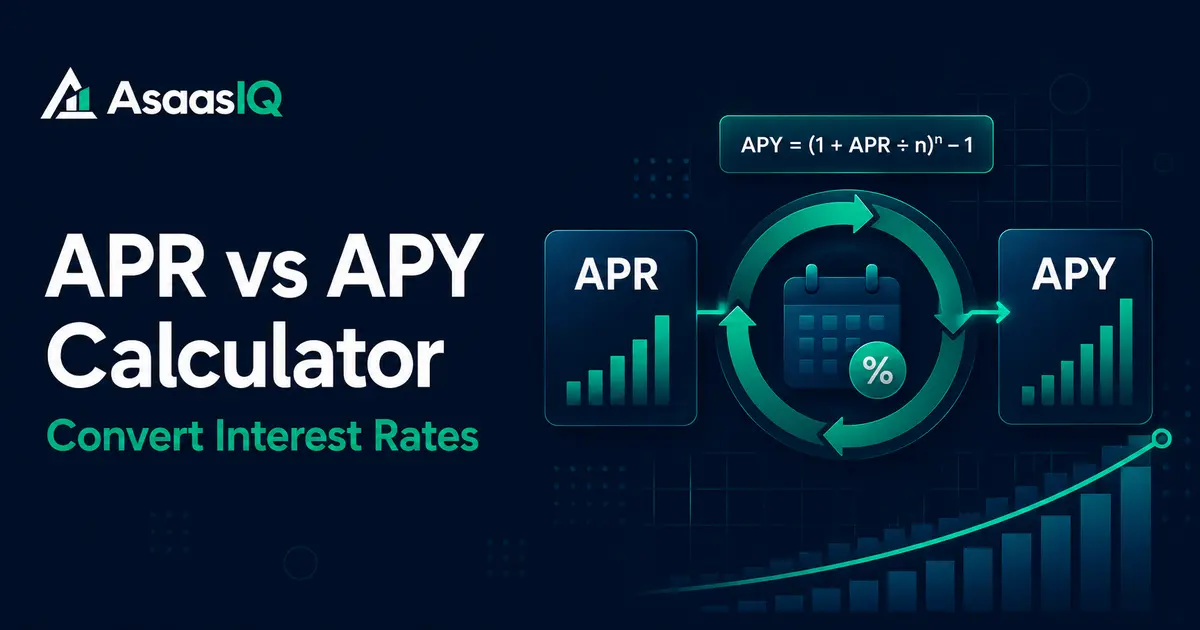
APR and APY can describe the same underlying interest rate differently. APR usually states an annual rate without adding the effect of within-year compounding, while APY shows the effective annual result after compounding.
At a 6% nominal APR compounded monthly, the APY is approximately 6.17%.
APR to APY formula:
APY = (1 + APR ÷ n)^n − 1
Here, n is the number of compounding periods per year. This conversion is currency-neutral: it works for dollars, pounds, euros, rupees or any other currency because the inputs are percentages.
Converting between APR and APY
Pick a direction — APR to APY, or APY to APR — then work from:
- Annual rate.
- Compounding frequency: annual, semi-annual, quarterly, monthly, weekly, daily or continuous.
- Optional starting balance and number of years.
That gives you the converted annual rate, the difference in percentage points and basis points, one year's interest on an optional principal, and how the result changes across compounding frequencies.
Quick APR-to-APY example
Nominal APR:          6%
Compounding periods: 12 per year

APY = (1 + 0.06 ÷ 12)^12 − 1
    = 0.061678
    = 6.1678%
Rounded to two decimal places, the APY is 6.17%.
Quick APY-to-APR example
APY:                  6.1678%
Compounding periods: 12 per year

APR = 12 × ((1 + 0.061678)^(1 ÷ 12) − 1)
    ≈ 6.00%
The two calculations reverse each other when they use the same rate convention and compounding frequency.
What is APR?
APR stands for annual percentage rate. In everyday calculations, people often use APR to mean a nominal annual interest rate divided across periodic compounding intervals.
For example, a nominal 12% APR with monthly periodic interest implies approximately 1% per month:
12% ÷ 12 = 1% per month
However, a legally disclosed loan APR may be more complicated. In the United States, the Consumer Financial Protection Bureau explains that APR can represent the total cost of credit, including the interest rate and certain mandatory fees, expressed as a yearly percentage. Definitions and disclosure rules differ by product and country.
Therefore, do not assume every advertised or disclosed APR is merely a nominal interest rate that can be divided by 12. Check the lender's calculation and disclosure.
What is APY?
APY stands for annual percentage yield. It represents the effective amount earned over a year after accounting for compounding, assuming the stated conditions remain unchanged.
The US Federal Deposit Insurance Corporation describes APY as a percentage reflecting the total interest paid on an account based on the interest rate and compounding frequency over a 365-day period, or 366 days in a leap year.
APY commonly appears on:
- Savings accounts.
- Certificates or term deposits.
- Money market deposit accounts.
- Other interest-bearing deposit products.
An APY normally assumes interest remains in the account so future interest can be earned on previous interest. Fees, early withdrawals, tiered balances and variable rates can make actual earnings different.
APR versus APY at a glance
| Feature | APR | APY |
|---|---|---|
| Full name | Annual percentage rate | Annual percentage yield |
| Typical context | Borrowing or nominal rate quotation | Savings and deposit earnings |
| Includes within-year compounding in the displayed rate? | Usually no in a nominal-rate conversion | Yes |
| May include certain loan fees? | A legally disclosed APR may | Usually not maintenance fees |
| Best use | Compare compliant borrowing disclosures or identify a stated nominal rate | Compare deposit yields on a consistent annual basis |
| Requires compounding frequency for conversion? | Yes | Yes, when converting back to nominal APR |
The simple slogan "APR is what you pay; APY is what you earn" is helpful but incomplete. APR disclosure rules can incorporate fees, while an APY may not reflect account fees, withdrawal penalties, balance tiers or future rate changes.
The APR-to-APY formula
Use:
APY = (1 + r ÷ n)^n − 1
Where:
ris the nominal APR as a decimal.nis the number of compounding periods per year.
Common values for n:
| Frequency | n |
|---|---|
| Annual | 1 |
| Semi-annual | 2 |
| Quarterly | 4 |
| Monthly | 12 |
| Weekly | 52 |
| Daily | 365 |
Some products use 360-day conventions or other day-count rules. Use the convention stated by the provider when reproducing an official calculation.
Example: 5% APR compounded monthly
APY = (1 + 0.05 ÷ 12)^12 − 1
    = 5.1162%
At a starting balance of 10,000 with no deposits, withdrawals, fees or taxes:
One-year interest = 10,000 × 0.051162
                  ≈ 511.62
The nominal APR is 5%, but monthly compounding produces an effective annual yield of approximately 5.12%.
The APY-to-APR formula
To reverse the conversion:
APR = n × ((1 + APY)^(1 ÷ n) − 1)
For a 5% APY with monthly compounding:
APR = 12 × ((1.05)^(1 ÷ 12) − 1)
    ≈ 4.8889%
This means a nominal annual rate of approximately 4.89%, compounded monthly, produces an effective yield of 5% over one year.
How compounding frequency changes APY
Holding nominal APR constant, more frequent compounding increases APY because interest is added to the balance sooner.
| Compounding frequency | APY from 5% nominal APR |
|---|---|
| Annual | 5.0000% |
| Semi-annual | 5.0625% |
| Quarterly | 5.0945% |
| Monthly | 5.1162% |
| Weekly | 5.1246% |
| Daily | 5.1267% |
| Continuous | 5.1271% |
The benefit increases with frequency but at a diminishing rate. At common savings rates, the difference between daily and monthly compounding is often small. Account fees or balance requirements can matter far more.
Once you have the effective annual rate, Rule of 72 turns it into an approximate doubling time in seconds.
Continuous compounding
Continuous compounding is a mathematical limit rather than the normal way retail accounts credit interest.
Convert a nominal rate to an effective annual rate with:
APY = e^APR − 1
Convert back with:
APR = ln(1 + APY)
At a 5% nominal rate:
APY = e^0.05 − 1
    ≈ 5.1271%
Always confirm whether a product actually uses continuous compounding before applying this option.
APR, APY and effective annual rate
The effective annual rate, sometimes called EAR or EAY, is mathematically similar to APY: it measures the annual effect after compounding. This is a different question from CAGR, which measures growth actually observed between a beginning and ending value rather than converting a quoted rate.
Terminology varies by country and product. A conversion can be mathematically precise, but it cannot decide which legal disclosure applies. When comparing financial products:
- Use the same time period.
- Use the same balance and transaction assumptions.
- Separate interest from mandatory and optional fees.
- Check whether the rate is fixed or variable.
- Read the provider's official disclosure.
Why a legal loan APR may not convert cleanly to APY
The mathematical conversion assumes APR is a nominal periodic interest rate. A legally disclosed consumer-loan APR may also reflect upfront fees, closing costs or another prescribed calculation method.
Those costs do not necessarily compound like interest. Consequently:
- Converting the disclosed APR with the simple APY formula may not reproduce the loan's true cash flows.
- Two loans with the same APR can have different payment timing or fee structures.
- A loan amortisation schedule is better for calculating actual payments and total cost.
- Credit-card interest can depend on daily balances, grace periods, transactions and payments.
Use this converter for rate mathematics. Use product-specific cash flows for borrowing decisions.
Comparing two savings accounts
Suppose Account A advertises 5% nominal interest compounded monthly, while Account B advertises 5.10% APY.
Convert Account A:
Account A APY = (1 + 0.05 ÷ 12)^12 − 1
              = 5.1162%
On the quoted rates alone, Account A's effective yield is slightly higher. But the decision is incomplete until you compare — much like choosing between a savings account and a money market fund comes down to more than the headline rate:
- Monthly or annual maintenance fees.
- Minimum balance requirements.
- Introductory versus ongoing rates.
- Deposit insurance or protection.
- Withdrawal restrictions.
- Early-withdrawal penalties.
- Tax treatment.
- Whether the rate can change.
A difference of 0.0162 percentage points equals approximately 1.62 in annual interest per 10,000 before tax and fees. A small account fee could reverse the result.
Comparing borrowing costs
For loans, compare the lender's legally required APR disclosures where applicable, but also examine:
- Total amount borrowed.
- Finance charge.
- Monthly payment.
- Number and timing of payments.
- Origination and mandatory fees.
- Variable-rate conditions.
- Prepayment penalties.
- Late-payment consequences.
Do not compare a deposit APY directly with a disclosed loan APR as though the two products have identical cash-flow rules.
Variable rates, introductory offers and tiers
An advertised APY is not necessarily a forecast for several years.
Variable rates
The institution may change the interest rate after opening. A one-year projection using today's APY assumes the rate remains unchanged.
Introductory rates
A promotional rate may apply only for a short period. Calculate each period separately instead of applying the introductory APY to the whole year.
Tiered rates
Different portions of a balance may earn different rates, or the entire balance may receive a rate based on the achieved tier. You need the provider's exact tier method.
Required activity
Some accounts require deposits, card transactions or other conditions. Missing them can produce a lower yield.
Fees, taxes and inflation
APY is not automatically your after-fee, after-tax or inflation-adjusted return — the same caution applies to mutual fund fees, where a small ongoing expense ratio compounds into a much larger gap than it first appears.
For a simplified net-yield estimate:
Net annual earnings = balance × APY − annual account fees
This shortcut assumes a constant balance and does not capture the timing of fees. Taxes depend on residence, account type and local rules.
To estimate purchasing-power growth after obtaining the nominal effective rate:
Real return = (1 + nominal effective return) ÷ (1 + inflation) − 1
See Real Return Calculator: Adjust Returns for Inflation for that separate step rather than mixing every concept into one headline rate.
APR and APY in Excel or Google Sheets
If nominal APR is in cell B2 and periods per year are in B3:
=(1+B2/B3)^B3-1
If APY is in B2 and periods per year are in B3:
=B3*((1+B2)^(1/B3)-1)
For continuous compounding:
APR to APY: =EXP(B2)-1
APY to APR: =LN(1+B2)
Enter 6% as 6% or 0.06, not as the number 6, unless the spreadsheet formula divides it by 100.
Common mistakes
- Comparing an APR from one product directly with an APY from another.
- Entering 6 instead of 0.06 in a formula.
- Forgetting to specify compounding frequency.
- Treating a disclosed loan APR as a simple nominal rate.
- Ignoring fees, minimum balances and penalties.
- Projecting a variable APY as if it were fixed.
- Confusing compounding frequency with interest-crediting frequency.
- Assuming daily compounding creates a large advantage at modest rates.
- Comparing rates from different currencies without considering currency risk.
Frequently asked questions
Is APY always higher than APR?
For the same positive nominal rate, more than one compounding period and no special fees, effective APY is higher than nominal APR. With annual compounding, they are equal. Legal APRs and APYs may describe different products and cost components, so the simple comparison is not universal.
What is 5% APR compounded monthly as APY?
Approximately 5.1162%, normally displayed as 5.12%.
What nominal APR produces 5% APY with monthly compounding?
Approximately 4.8889%.
Should I compare savings accounts using APR or APY?
Compare APYs calculated under the same disclosure standard, then examine fees, balance requirements, rate variability, access and protection. APY is designed to make compounding-aware deposit comparisons easier.
Should I compare loans using APY?
Generally, compare the official APR and complete payment disclosures required for that loan in your jurisdiction. The mathematical effective annual rate can be informative, but it does not replace a cash-flow or amortisation analysis.
Does APY include account fees?
Not necessarily. Maintenance or activity fees can reduce actual earnings. Review the account's fee schedule and conditions.
Does a higher compounding frequency always mean a better account?
Not by itself. Compare effective APY, fees, restrictions, rate stability and provider risk. Once APY is known, its compounding effect is already reflected in the figure.
Bottom line
APR and APY are not competing labels for exactly the same thing. A nominal APR states a yearly rate before within-year compounding; APY expresses the effective annual result after compounding.
Use:
APY = (1 + APR ÷ n)^n − 1
and:
APR = n × ((1 + APY)^(1 ÷ n) − 1)
Then compare fees, terms, rate changes and actual cash flows. The calculation is precise only when the input definitions and compounding assumptions are precise.
Sources & References
Educational information only
AsaasIQ provides general educational content about investing in Pakistan. Nothing on this site is personalized financial, tax, legal or investment advice. AsaasIQ is not a financial advisor, broker, asset management company or affiliate of the Pakistan Stock Exchange. Always verify current facts, rates and regulations with official sources before acting.

Founder and Editor, AsaasIQ
Software engineer and the founder of AsaasIQ. Not a licensed financial adviser -- every article is educational and source-linked.
Published August 2026 · Last reviewed August 2026