
Rule of 72 Calculator: How Long to Double Your Money
Use the Rule of 72 calculator to estimate how long money takes to double. Compare the shortcut with the exact formula, examples, inflation and fees.
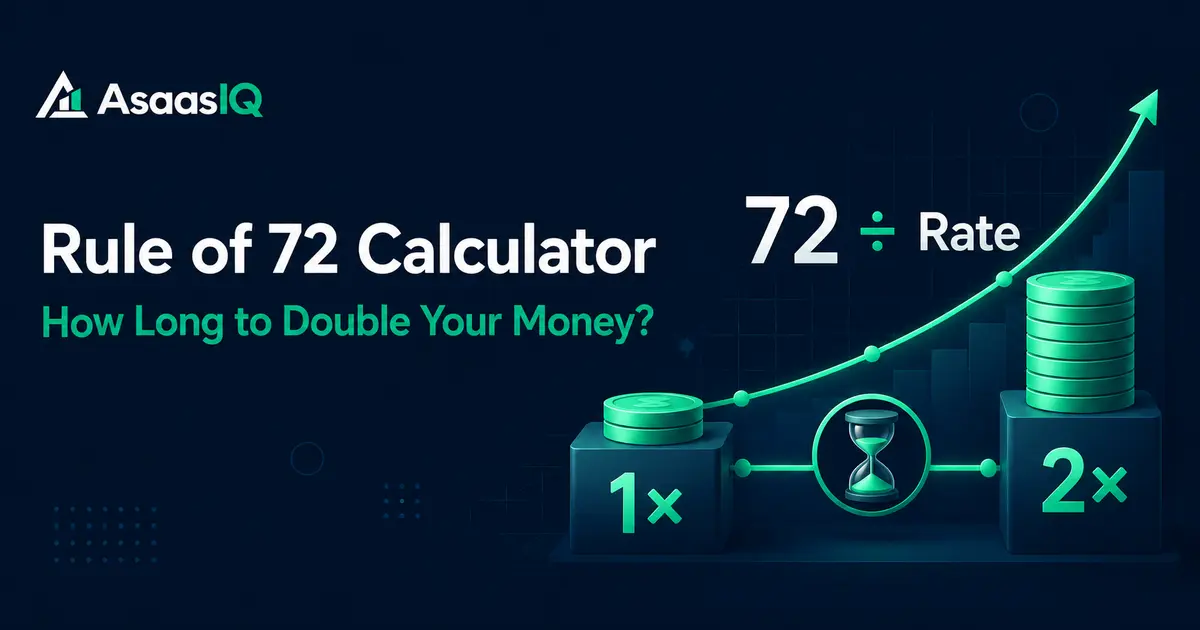
At an 8% annual compound return, money takes roughly nine years to double. You can estimate that in seconds by dividing 72 by 8.
Rule of 72:
Approximate years to double = 72 ÷ annual rate (%)
The Rule of 72 is a mental-math shortcut, not a promise of investment performance. It works best with a reasonably steady annual compound rate and no contributions or withdrawals.
How to use the Rule of 72
Divide 72 by an annual rate to estimate doubling time, or divide 72 by a target number of years to estimate the required rate.
Annual rate: 8%

72 ÷ 8 = 9 years
Reverse calculation:
Target doubling time: 10 years

72 ÷ 10 = 7.2% per year
Below, you'll also find the exact mathematical answer, the difference from the shortcut, and adjustments for inflation and fees.
What is the Rule of 72?
The Rule of 72 estimates how many periods it takes for a value growing at a compound percentage rate to double. When the rate is annual, the answer is in years. FINRA uses the same definition in its financial knowledge material: divide 72 by the interest percentage per period to estimate the number of periods required for doubling.
It can also answer the reverse question: divide 72 by a desired number of years to estimate the annual percentage rate needed to double.
The rule is popular because 72 is divisible by many common rates—2, 3, 4, 6, 8, 9 and 12—making mental calculations easy.
Rule of 72 formula
For doubling time:
Years to double ≈ 72 ÷ annual compound rate (%)
For the required rate:
Required annual rate (%) ≈ 72 ÷ target years
Examples:
| Annual rate | Rule of 72 doubling time |
|---|---|
| 2% | 36 years |
| 3% | 24 years |
| 4% | 18 years |
| 5% | 14.4 years |
| 6% | 12 years |
| 7% | 10.3 years |
| 8% | 9 years |
| 9% | 8 years |
| 10% | 7.2 years |
| 12% | 6 years |
These are estimates based on a constant rate. Real investments do not usually grow in a straight line.
The exact doubling-time formula
The exact formula uses logarithms:
Exact years = ln(2) ÷ ln(1 + r)
Here, r is the annual rate as a decimal. At 8%:
Exact years = ln(2) ÷ ln(1.08)
            = 9.006 years
The Rule of 72 gives 9 years, so it is exceptionally close in this example.
| Rate | Rule of 72 | Exact doubling time | Difference |
|---|---|---|---|
| 3% | 24.00 years | 23.45 years | +0.55 |
| 6% | 12.00 years | 11.90 years | +0.10 |
| 8% | 9.00 years | 9.01 years | -0.01 |
| 10% | 7.20 years | 7.27 years | -0.07 |
| 12% | 6.00 years | 6.12 years | -0.12 |
Rounding and compounding frequency can change the displayed result slightly.
Why does the Rule of 72 work?
Compound growth follows:
Future value = Present value × (1 + rate)^years
For a doubling, future value is twice present value:
2 = (1 + rate)^years
Solving produces the logarithmic formula above. The number 72 is a convenient approximation near common investment rates. It is not a physical law or a guaranteed schedule.
Rule of 72 versus Rule of 70 and Rule of 69.3
You may also encounter two related shortcuts:
- Rule of 70: easy to use with rates such as 5%, 7% and 10%.
- Rule of 69.3: closely linked to continuous compounding because the natural logarithm of 2 is approximately 0.693.
- Rule of 72: often more convenient for mental arithmetic and accurate around common mid-single-digit to low-double-digit annual rates.
For planning software, use the exact formula. For a conversation or quick plausibility check, 72 is usually sufficient.
Nominal doubling is not purchasing-power doubling
If an account doubles, that does not necessarily mean it can buy twice as much. Inflation also compounds — the full mechanics are in Real Return Calculator: Adjust Returns for Inflation.
Suppose an investment earns 8% while inflation averages 3%. The exact real return is:
Real return = (1.08 ÷ 1.03) − 1
            = 4.85%
Nominal doubling time is about nine years. Doubling purchasing power takes approximately:
Exact real doubling time = ln(2) ÷ ln(1.0485)
                         ≈ 14.62 years
The Rule of 72 estimate is roughly 14.84 years. This is why long-term goals should consider real, not only nominal, growth.
Fees and taxes slow doubling
The headline investment return is not always the return that compounds for you. Ongoing fees, trading costs and tax can lengthen doubling time — see Understanding Mutual Fund Fees and Expense Ratios for how much a seemingly small expense ratio can compound into over time.
Assume a portfolio's gross return is 8%, but recurring expenses reduce the net return to 7.25%:
Gross estimate: 72 ÷ 8    = 9.00 years
Net estimate:   72 ÷ 7.25 = 9.93 years
That difference compounds. Show gross and net assumptions separately instead of hiding costs inside one optimistic rate.
Tax calculations depend on jurisdiction, account type, income, distributions, realisation timing and allowances. Treat any effective after-tax rate as an estimate, not personalised tax advice.
The rule does not work for monthly contributions
The Rule of 72 assumes one amount compounds without additional deposits or withdrawals. It does not correctly answer "When will my portfolio balance double?" if you keep adding money, because part of the increase comes from contributions rather than return.
For regular investments, use the Monthly Investment Calculator instead, with:
- Starting balance.
- Contribution amount and frequency.
- Expected rate.
- Compounding convention.
- Fees and inflation.
- Time horizon.
You can still use the rule to understand how the invested portion compounds, but not to predict the account's actual doubling date.
What happens with variable investment returns?
Market returns vary. A portfolio might rise 20%, fall 12% and then rise 9%. An arithmetic average of those percentages does not reproduce the compounded outcome.
For historical data, calculate CAGR from beginning value, ending value and time, then use that rate only as a description of the past. For future planning, use a range of assumptions rather than treating historical CAGR as a forecast.
Volatility also matters. Two paths with the same long-term CAGR can expose investors to very different drawdowns and behaviour risks. Doubling time is one metric, not a complete comparison.
Can the Rule of 72 apply to inflation?
Yes. Divide 72 by an inflation rate to estimate how long it takes the general price level to double.
| Inflation | Approximate time for prices to double |
|---|---|
| 2% | 36 years |
| 3% | 24 years |
| 4% | 18 years |
| 6% | 12 years |
| 8% | 9 years |
This does not mean every price doubles on that schedule. Consumer price indexes represent changing baskets and averages; individual expenses can behave differently.
Can it apply to debt?
The same compounding principle can estimate how quickly an unpaid balance would double at a fixed rate with no payments, fees or rate changes.
At 18%, the shortcut gives:
72 ÷ 18 = 4 years
Actual loan and credit-card balances depend on payment schedules, daily or monthly compounding, new charges, fees and variable rates. Use the lender's disclosed annual percentage rate and a proper amortisation calculation for decisions.
Doubling more than once
Every doubling multiplies the original amount by two:
| Number of doublings | Multiple of starting amount |
|---|---|
| 1 | 2× |
| 2 | 4× |
| 3 | 8× |
| 4 | 16× |
At an estimated nine years per doubling, 10,000 becomes about 20,000 after nine years, 40,000 after 18 years and 80,000 after 27 years—if the rate remains 8%, returns compound, and there are no fees, taxes or withdrawals.
This illustrates why time matters, but it should not be presented as a guaranteed projection.
Reverse Rule of 72 examples
Double in 12 years
72 ÷ 12 = 6%
The exact annual rate is 2^(1/12) − 1, or about 5.95%.
Double in 15 years
72 ÷ 15 = 4.8%
The exact annual rate is about 4.73%.
Double in 20 years
72 ÷ 20 = 3.6%
The exact annual rate is about 3.53%.
The reverse rule is useful for testing whether a goal implies a plausible return. If the required rate looks unusually high, consider more time, more contributions or a lower target rather than assuming more risk will reliably solve the gap.
Rule of 72 in Excel and Google Sheets
If the annual rate is entered as 8% in cell B2:
Rule of 72 years: =72/(B2*100)
Exact years:      =LN(2)/LN(1+B2)
If the rate is entered as the number 8 rather than 8%:
Rule of 72 years: =72/B2
Exact years:      =LN(2)/LN(1+B2/100)
To calculate the exact annual rate needed for a target number of years in B3:
=2^(1/B3)-1
Format that result as a percentage.
When is the Rule of 72 useful?
Use it to:
- Make a quick compounding estimate.
- Compare two net annual rates.
- Sense-check a projection.
- Explain the long-run effect of fees or inflation.
- Estimate how quickly fixed-rate debt can grow.
- Work backwards from a target doubling period.
Do not rely on it alone to:
- Select an investment.
- Predict volatile market returns.
- Model contributions or withdrawals.
- Calculate a guaranteed maturity date.
- Compare investments with different risks, liquidity or taxes.
- Replace an exact loan or retirement calculation.
Common mistakes
- Entering
0.08when8is expected, or vice versa. - Calling an expected return guaranteed.
- Ignoring fees and tax.
- Confusing nominal doubling with purchasing-power doubling.
- Applying the rule to simple interest.
- Using an arithmetic average for volatile returns.
- Treating contributions as investment growth.
- Comparing rates quoted with different compounding periods.
Frequently asked questions
How long does it take to double money at 7%?
The Rule of 72 gives about 10.29 years. The exact annual-compounding answer is about 10.24 years.
How long does it take to double money at 10%?
The shortcut gives 7.2 years. The exact annual-compounding answer is approximately 7.27 years.
What interest rate doubles money in 10 years?
The Rule of 72 estimates 7.2%. The exact annual compound rate is approximately 7.18%.
Does the Rule of 72 include compound interest?
Yes. It is specifically an approximation of compound doubling time. It does not correctly model simple interest.
Is the Rule of 72 accurate?
It is a close approximation around many common annual rates, especially near 8%. Use the logarithmic formula when dates, high rates, low rates or precise comparisons matter.
Does money really double every seven years?
Only at a sufficiently high compound rate. The Rule of 72 implies about 10.29% for a seven-year doubling. Investments do not provide that return consistently or without risk.
Bottom line
The Rule of 72 turns an annual compound rate into an intuitive time estimate:
Approximate doubling years = 72 ÷ annual rate (%)
It is excellent for mental maths and quick comparisons. Use the exact formula for precision, reduce the rate for fees, distinguish nominal from real growth, and use a proper cash-flow calculation when contributions or withdrawals are involved.
Sources & References
Educational information only
AsaasIQ provides general educational content about investing in Pakistan. Nothing on this site is personalized financial, tax, legal or investment advice. AsaasIQ is not a financial advisor, broker, asset management company or affiliate of the Pakistan Stock Exchange. Always verify current facts, rates and regulations with official sources before acting.

Founder and Editor, AsaasIQ
Software engineer and the founder of AsaasIQ. Not a licensed financial adviser -- every article is educational and source-linked.
Published August 2026 · Last reviewed August 2026