Mortgage Overpayment Calculator: Save Interest and Time
Calculate how regular or lump-sum mortgage overpayments could reduce interest and shorten your loan term. See formulas, examples and repayment cautions.
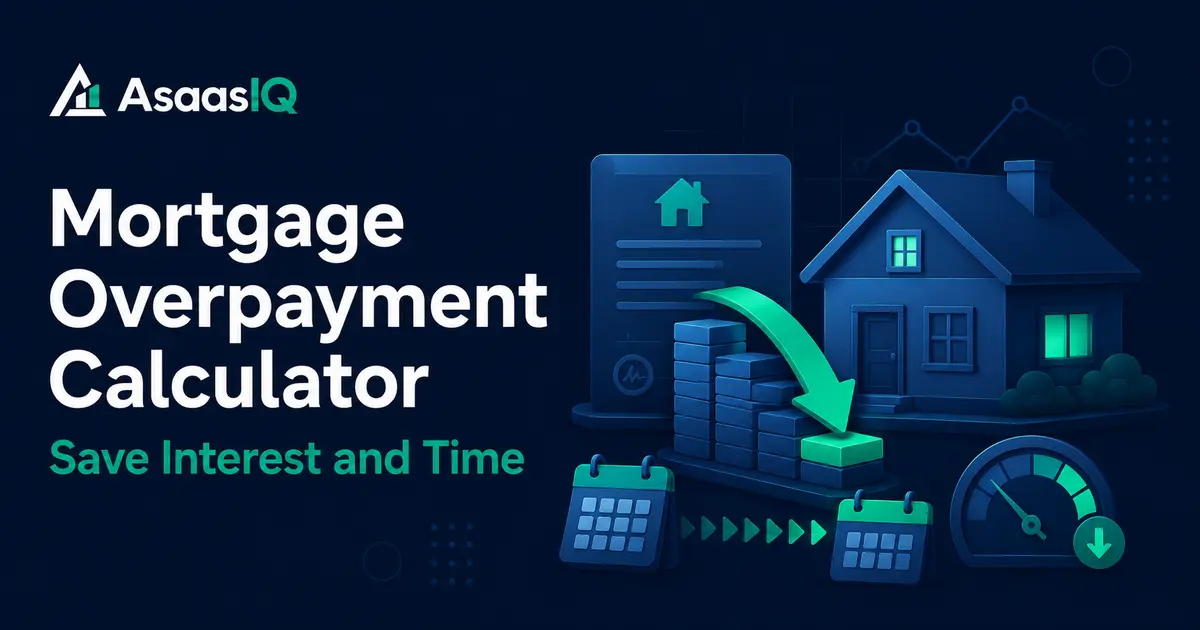
A mortgage overpayment is money paid above the required repayment. If the lender applies it to principal, the balance falls sooner, future interest is calculated on a smaller amount, and the mortgage may finish earlier.
Comparing the current repayment schedule with a plan that includes regular extra payments, one-off lump sums or both should estimate: interest saved, months or years removed from the term, the revised payoff date, the new payment if the lender recalculates it, and the effect of any fees or early-repayment charges.
Quick answer: Overpayments can reduce mortgage interest and term, but first confirm that the lender applies extra money to principal and check any annual allowance, early-repayment charge or minimum-payment rule.
The calculation itself is currency-neutral. Contract terms, consumer protections and fees are not, so check the actual mortgage agreement before relying on any estimate.
Mortgage overpayment calculator
Working through an overpayment scenario means gathering the current mortgage balance, current interest rate, remaining term, current required payment if known, mortgage type, and the regular monthly overpayment or one-off payment amount and date you're considering — plus any early-repayment allowance or charge that applies.
The result compares at least two schedules: continuing with required payments only, and making the selected overpayments. For each, the payoff date, total interest, total paid and monthly balance show the estimated saving.
The US Consumer Financial Protection Bureau says borrowers may be allowed to make extra principal payments that repay a mortgage faster and with less interest, but should confirm that extra payments are applied to principal: CFPB mortgage-servicer guidance.
Worked example: add 200 per month
Assume:
| Input | Amount |
|---|---|
| Current balance | 300,000 |
| Annual interest rate | 5% |
| Remaining term | 25 years |
| Remaining payments | 300 |
| Regular monthly overpayment | 200 |
Under a fixed-rate monthly model, the required principal-and-interest payment works out to approximately 1,753.77.
| Estimated result | Standard schedule | With 200 extra monthly |
|---|---|---|
| Monthly payment | 1,753.77 | 1,953.77 |
| Payoff time | 300 months | 246 months |
| Total interest | 226,131.04 | 179,779.80 |
| Term reduction | — | 54 months |
| Interest saving | — | 46,351.24 |
The illustration assumes the 5% rate remains unchanged, every payment is on time, the extra amount is applied immediately to principal, no fees apply, and the required payment stays fixed.
Real mortgages may calculate interest daily, change rates, recalculate payments or charge for certain overpayments.
Standard mortgage payment formula
For a fixed-rate repayment mortgage:
PMT = P × r × (1 + r)^n ÷ [(1 + r)^n − 1]
Where:
PMTis the scheduled payment.Pis the current principal balance.ris the periodic rate.nis the number of remaining payments.
For a simplified monthly model:
r = annual interest rate ÷ 12
n = remaining years × 12
If the lender uses daily interest, an annual-rate-divided-by-12 model will only approximate the statement — treat the underlying rate itself as a convention, not a physical constant, since how it compounds changes the exact numbers.
How an overpayment simulation works
For each month:
Interest = opening balance × periodic rate
Principal paid = total payment − interest
Closing balance = opening balance + interest − total payment
The simulation repeats until the balance reaches zero. The final payment needs to be capped at the remaining balance plus accrued interest so the model never produces a negative loan.
An overpayment saves future interest because it reduces the balance before later interest is calculated.
Regular overpayment versus lump sum
Regular overpayment
A fixed extra amount is added to each required payment. This can be easier to sustain from monthly income and spreads cash-flow impact over time.
Lump-sum overpayment
A one-off payment reduces the principal immediately. Earlier principal reduction usually saves more interest than the same amount paid much later, assuming the rate and fees are unchanged.
Using the same 300,000 balance, 5% rate, 25-year term and 1,753.77 scheduled payment, an immediate 20,000 lump sum produces this simplified estimate:
| Result | Estimate |
|---|---|
| Revised payoff time | 264 months |
| Term reduction | 36 months |
| Total interest | 181,564.92 |
| Interest saving | 44,566.12 |
This assumes the lender keeps the monthly payment at 1,753.77. If the lender lowers the payment instead, the term and savings will differ.
Reduce the term or reduce the payment?
After a lump sum, a lender may offer or automatically apply one of two outcomes.
Keep the payment and shorten the term
The payment stays near its previous level. More of it reaches principal, and the mortgage finishes earlier. This generally produces the larger interest saving.
Keep the term and recalculate the payment
The remaining balance is spread over the original end date, lowering the required monthly payment. This improves cash flow but normally saves less interest than maintaining the payment.
A transparent comparison shows both modes and clearly labels which one is being modelled.
What counts as an overpayment?
Common forms include a fixed extra amount each month, rounding the payment upward, one additional payment per year, a one-off lump sum, a temporary higher payment for several months, and directing a bonus or windfall to principal.
Don't assume that paying earlier in the month or splitting one monthly payment automatically produces the same effect — lender posting and interest rules matter.
Confirm how the lender applies extra money
An extra payment may be handled in different ways: applied directly to principal, held as an advance against future instalments, used first for fees or accrued interest, applied only after the lender receives special instructions, or used to recalculate the monthly payment.
Ask the servicer how to mark a principal-only overpayment and verify the next statement. A lower principal balance — not merely a later due date — is the key signal that it worked.
Early-repayment charges and prepayment penalties
Some mortgages charge a fee when the borrower repays too much, repays the full loan or exits a fixed deal early.
The CFPB explains that some US loans include a prepayment penalty, often for full repayment or a large payment within specified early years, although small principal payments may not normally trigger it. Check your documents: CFPB prepayment-penalty explanation.
Other countries and products may offer an annual overpayment allowance, such as a percentage of balance, but the definition and reset date vary. A realistic estimate needs to account for a fee-free annual allowance, whether it's measured against the original or current balance, a calendar-year or mortgage-year reset, and a fixed or percentage charge on any excess.
Don't hard-code one lender's allowance as a universal rule.
Net saving after fees
Gross interest saved can overstate the benefit if overpayments trigger costs.
Net saving = interest saved − overpayment charges − administrative costs
A charge paid today and an interest saving spread over 20 years are also not economically identical. A more advanced comparison can show present value, but at minimum, show fee-adjusted nominal savings rather than the gross figure alone.
Fixed, variable and tracker rates
The simplest model assumes one rate for the remaining term. That is rarely a perfect forecast.
For fixed-rate periods: use the current rate until the fixed period ends, add a future-rate scenario rather than assuming certainty, and check the overpayment allowance and charge period.
For variable or tracker mortgages: allow for dated rate changes, recalculate interest each period, and compare scenarios for higher and lower future rates.
An overpayment made before a rate increase can save more interest than the same payment under a lower-rate path, but future rates cannot be known in advance.
Repayment versus interest-only mortgages
Repayment mortgage
The required payment covers interest and principal, so the balance declines over time. Overpayments accelerate that decline.
Interest-only mortgage
The scheduled payment may cover only interest, leaving the principal due later. An overpayment can reduce principal if the contract permits, but don't apply a standard repayment schedule unless the mortgage is actually converted — an interest-only mortgage will not amortise from regular interest payments alone.
Offset mortgages
An offset mortgage links savings to the loan so interest is charged on a lower net balance. Keeping cash in the offset may create an interest benefit similar to overpaying while retaining some access, subject to product rules.
The choice depends on the mortgage and savings rates, tax treatment, withdrawal access, product fees, and whether the offset changes required payments or term. A basic overpayment estimate can exclude offsets and simply state that limitation rather than approximate one.
Overpay mortgage or invest?
Overpaying provides a relatively predictable saving equal to avoided mortgage interest, adjusted for fees and tax treatment. Investing offers uncertain returns and liquidity but may outperform or underperform.
Worth comparing: the mortgage rate, expected investment return after fees and taxes, investment risk and horizon, emergency-fund needs, retirement-account benefits, access to overpaid money, and any early-repayment charges.
Don't compare a guaranteed mortgage saving with an optimistic investment return as if both were certain — run multiple investment scenarios instead of one.
Keep emergency savings before locking away cash
Mortgage overpayments may be difficult or impossible to withdraw. A homeowner without accessible reserves may have to borrow again when repairs, medical bills or income disruption occur.
Before sending a lump sum, weigh essential monthly expenses, job stability, insurance coverage, upcoming property repairs, other high-interest debt, and whether the mortgage permits redraw. See Why You Should Build an Emergency Fund Before You Start Investing rather than setting one reserve target for every household.
Pay higher-interest debt first?
If a credit card costs 20% and the mortgage costs 5%, paying the card may provide a larger direct interest saving, assuming fees and other considerations don't change the comparison.
Priority can also depend on tax deductibility, secured versus unsecured status, promotional rates, minimum-payment pressure, legal or arrears consequences, and available emergency cash.
There's no single automatic recommendation here — see the debt snowball vs avalanche calculator for how to rank multiple debts by balance or by rate before deciding whether the mortgage or something else gets the extra payment.
Monthly overpayment or annual lump sum?
If the total amount is identical and there are no fees or allowance constraints, paying earlier generally reduces interest sooner.
For example, 200 monthly reaches principal throughout the year, while a 2,400 year-end payment arrives later. But annual bonuses, lender minimums and allowance periods may make a lump sum more practical. Use exact dates rather than assuming all lump sums happen today.
What happens if rates change?
There are several possible lender responses: keep the payment unchanged and alter the term, recalculate the payment to preserve the term, recalculate both under product rules, or change the rate while retaining the overpayment instruction.
A fuller schedule should model dated rate changes and a chosen recast rule. A simple estimate must disclose its fixed-rate assumption prominently.
Inflation and the value of future payments
A fixed nominal payment may feel smaller over time if income and prices rise, but inflation does not remove the contractual debt.
The standard schedule should show nominal interest and payments because those match statements. An optional present-value view can discount future cash flows, but it should not replace the nominal schedule. Avoid mixing an inflation-adjusted interest saving with nominal fees.
Common mistakes
Ignoring charges. Check allowances, early-repayment fees and administration costs before paying.
Assuming the rate never changes. Run alternative future-rate scenarios.
Treating a lower due amount as principal reduction. Confirm how the lender posted the extra payment.
Emptying accessible savings. An overpaid mortgage may not provide easy emergency access.
Comparing gross savings with investment returns. Use after-fee, after-tax and risk-aware assumptions.
Entering the original loan instead of current balance. Use today's outstanding principal and remaining term for an existing mortgage.
Forgetting the final partial payment. Cap the final payment and calculate the exact payoff month.
Spreadsheet formulas
For a fixed-rate loan, calculate the scheduled payment with:
=-PMT(5%/12, 25*12, 300000)
In an amortisation table:
Monthly interest = opening balance × 5% ÷ 12
Total payment = MIN(opening balance + interest, scheduled payment + overpayment)
Principal = total payment − interest
Closing balance = opening balance − principal
Repeat until closing balance is zero. Spreadsheet sign conventions vary; verify outputs before relying on a template.
After buying, before overpaying
If you're weighing whether to buy at all, the mortgage rate and term used here plug straight into the rent vs buy calculator — the same balance, rate and remaining-balance formula, just used to compare housing paths instead of overpayment scenarios. And however you fund an extra payment, net worth is the balance-sheet view that shows an overpayment's real effect: cash falls, the mortgage liability falls by the same amount today, and the payoff shows up later as avoided interest.
Frequently asked questions
Does overpaying a mortgage reduce interest?
Usually, if the extra money is applied to principal. A lower balance means less future interest, subject to rate changes, fees and contract rules.
Is it better to overpay monthly or as a lump sum?
Earlier principal reduction generally saves more interest, but affordability, allowance periods and fees matter. Model exact payment dates.
Will an overpayment reduce my monthly payment?
Not always. The lender may keep the payment and shorten the term or recalculate the payment over the original term. Ask how your product works.
Can I overpay a fixed-rate mortgage?
Possibly, but an allowance or early-repayment charge may apply. Check the mortgage offer and ask the lender.
Should I overpay or keep cash in savings?
Compare the mortgage saving with the after-tax savings return and the value of liquidity. Don't remove essential emergency cash merely to shorten the mortgage.
What balance should I enter?
Use the current outstanding principal, current rate and remaining term — not the original mortgage amount.
Why does my lender show a different saving?
The lender may use daily interest, exact posting dates, changing rates, different rounding, fees or payment-recalculation rules.
Can overpayments be withdrawn later?
Only if the mortgage has an offset, redraw, flexible or borrow-back feature permitting it. Standard principal overpayments may be irreversible.
Does this work in any currency?
Yes. Use one currency throughout and enter contract-specific fees and allowances manually.
Final takeaway
Mortgage overpayments can reduce principal, interest and term, but the benefit depends on timing, rate, lender treatment and fees.
Work out the standard schedule first, add realistic overpayments, subtract any charges, keep emergency liquidity and confirm the lender's instructions before sending extra money.
Sources & References
Educational information only
AsaasIQ provides general educational content about investing in Pakistan. Nothing on this site is personalized financial, tax, legal or investment advice. AsaasIQ is not a financial advisor, broker, asset management company or affiliate of the Pakistan Stock Exchange. Always verify current facts, rates and regulations with official sources before acting.

Founder and Editor, AsaasIQ
Software engineer and the founder of AsaasIQ. Not a licensed financial adviser -- every article is educational and source-linked.
Published August 2026 · Last reviewed August 2026