Debt Snowball vs Avalanche Calculator: Compare Payoff Plans
Compare debt snowball and avalanche payoff plans. Estimate your debt-free date, total interest, repayment order and the effect of extra monthly payments.
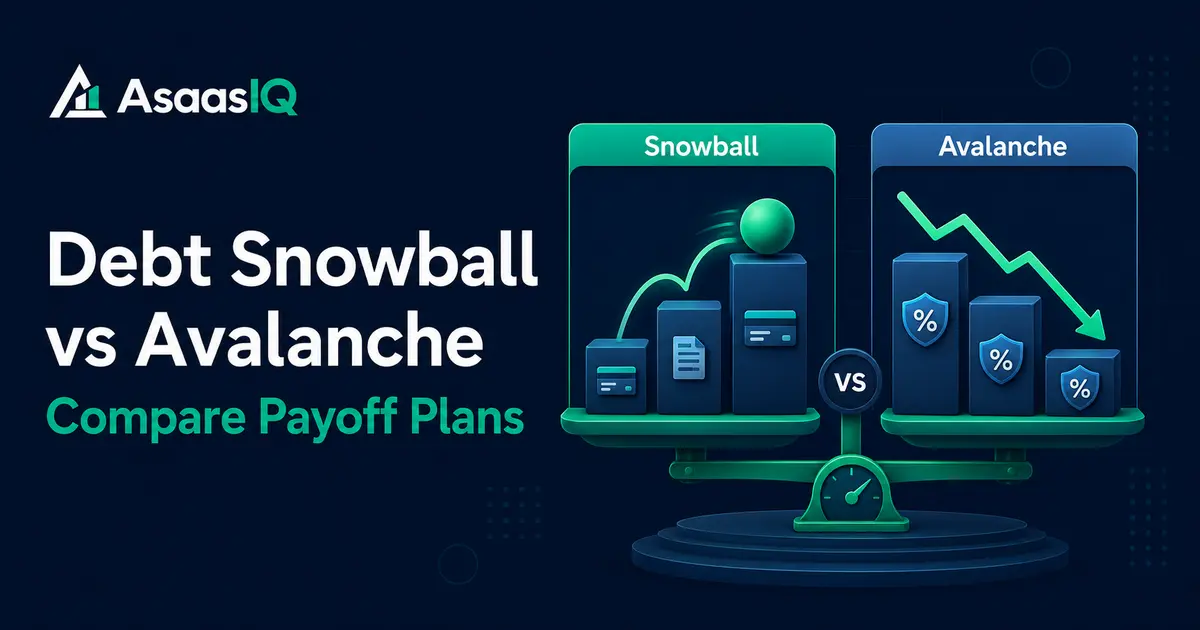
The debt snowball and debt avalanche methods use the same basic rule: make required payments on every debt and direct extra money toward one priority balance. The difference is the order.
- Debt snowball: target the smallest balance first.
- Debt avalanche: target the highest interest rate first.
The avalanche usually minimises interest when payment assumptions are identical. The snowball may provide an earlier visible win, which some people find easier to maintain.
Comparing both plans requires your balances, annual percentage rates, minimum payments and extra monthly budget. The output should be the payoff order, debt-free date, total interest and month-by-month schedule for each—not a declaration that one method is universally "best."
Quick answer: Choose avalanche to prioritise mathematical interest savings. Choose snowball if clearing a small account sooner is more likely to keep you following the plan. Consistent execution matters more than a theoretically optimal plan that you abandon.
Comparing snowball and avalanche
For each debt, you need:
- Account label.
- Current balance.
- Interest rate or APR.
- Current minimum monthly payment.
- Optional promotional-rate end date.
Then, for the plan overall:
- Extra amount available each month.
- Start date.
- Optional one-time payments.
- Whether minimum payments stay fixed or change with balance.
From there you can compare three scenarios:
- Minimum payments only.
- Snowball order.
- Avalanche order.
Useful outputs include estimated debt-free month, total interest paid, total amount paid, first account paid off, complete payoff order, and interest and time saved versus the minimum-only baseline.
The US Consumer Financial Protection Bureau describes the same two approaches: the highest-interest method attacks the costliest debt, while the snowball method attacks the smallest balance and rolls freed payments into the next debt.
How the debt snowball method works
The snowball method ranks debts from the smallest outstanding balance to the largest, regardless of interest rate.
Each month:
- Make at least the required payment on every debt.
- Put all available extra money toward the smallest balance.
- When it reaches zero, roll its former payment into the next-smallest balance.
- Continue until every included debt is paid.
The "snowball" is the growing payment directed at the active target. The total monthly debt budget should not shrink when one account disappears.
Why people choose snowball
- The first payoff may arrive sooner.
- Fewer open balances can simplify money management.
- Visible milestones can reinforce the habit.
- The priority order is easy to understand.
Trade-off
Because balance rather than rate determines the order, a high-interest debt may continue accruing interest while a cheaper small debt is targeted. Snowball can therefore cost more than avalanche under otherwise identical assumptions.
How the debt avalanche method works
The avalanche method ranks debts by interest rate from highest to lowest.
Each month:
- Make at least the required payment on every debt.
- Put all available extra money toward the highest-rate balance.
- After it is repaid, roll the freed payment into the next-highest-rate debt.
- Continue until the included balances reach zero.
Why people choose avalanche
- It targets the most expensive borrowing first.
- It generally produces the lowest interest cost for a fixed payment budget.
- It can shorten repayment when rate differences are meaningful.
Trade-off
If the highest-rate balance is large, the first account payoff can take longer. The balance is still falling, but progress may feel less visible.
Snowball versus avalanche at a glance
| Feature | Snowball | Avalanche |
|---|---|---|
| First priority | Smallest balance | Highest interest rate |
| Main objective | Earlier visible wins | Lower interest cost |
| Rate considered in order? | No | Yes |
| Required payments on other debts | Continue | Continue |
| Freed payments rolled forward | Yes | Yes |
| Likely advantage | Motivation and simplicity | Mathematical efficiency |
| Possible disadvantage | More interest | Slower first milestone |
If the smallest balance is also the highest-rate debt, both methods initially choose the same account and may produce identical results.
Worked example
Assume three debts:
| Debt | Balance | APR | Minimum payment |
|---|---|---|---|
| Credit card | 3,500 | 22% | 120 |
| Personal loan | 7,000 | 12% | 180 |
| Store card | 1,200 | 18% | 50 |
The required payments total 350. An extra 300 makes the total monthly debt budget 650 — the 50/30/20 budget framework is one way to work out how much of your income can realistically go toward that extra amount.
Using a simplified monthly model in which interest is added at APR ÷ 12, fixed minimums are paid, unused payment budget rolls to the active target and final payments are capped at the remaining balance:
| Result | Snowball | Avalanche |
|---|---|---|
| First target | Store card | Credit card |
| First target cleared | Month 4 | Month 10 |
| All debts cleared | Month 21 | Month 21 |
| Estimated interest | 1,540.76 | 1,507.70 |
| Estimated total paid | 13,240.76 | 13,207.70 |
In this example, avalanche saves approximately 33.06 in interest, while snowball clears the first account six months earlier. The difference is modest because the balances, rates and relatively large extra payment compress the schedule.
Actual lender calculations may differ because of daily interest, statement dates, fees, changing minimums and payment allocation rules.
How a debt payoff calculation should work each month
A transparent monthly simulation can follow this sequence:
- Start with each account's opening balance.
- Add estimated interest for the month.
- Apply required payments to every active account.
- Rank active accounts using the selected strategy.
- Apply remaining budget to the priority account.
- If that account reaches zero, apply any same-month remainder to the next account.
- Record interest, payments and closing balances.
- Repeat until all balances are zero or the plan fails a safety limit.
A simplified monthly interest formula is:
Monthly interest = opening balance × APR ÷ 12
That is suitable for an educational estimate, but many revolving accounts calculate interest from an average daily balance. Disclose the convention you're using.
Why your result may differ from a statement
Debt payoff estimates are sensitive to details that a general calculation may not know:
- Daily versus monthly interest.
- Statement opening and closing dates.
- Compounding rules.
- New purchases.
- Late, annual or transfer fees.
- Promotional rates.
- Variable interest rates.
- Minimum-payment formulas.
- Payment allocation between purchases, transfers and cash advances.
- Prepayment charges on certain loans.
Use the schedule as a planning estimate and confirm settlement amounts with each lender before the final payment.
Minimum payments must come first
Both strategies assume required payments continue on all included debts. Directing everything to one account while missing another payment can trigger fees, penalty rates, credit damage or collection activity.
Reject any plan with a monthly budget below total required payments:
Payment shortfall = total minimum payments − available monthly budget
When the budget is insufficient, the relevant next step may be contacting lenders or a qualified nonprofit debt adviser—not choosing between snowball and avalanche.
Fixed versus declining minimum payments
Some instalment loans have fixed scheduled payments. Credit-card minimums may change with the balance and can include interest, fees, a percentage of principal or a floor amount.
Two useful approaches:
- Statement-payment mode: update minimums from current statements.
- Formula mode: estimate a percentage of balance subject to a minimum floor.
Never silently assume every minimum is 2% of balance. Terms differ by account and country.
For strategy comparison, a fixed total monthly budget is often clearer. When minimums fall, the difference remains available as extra repayment instead of being treated as spending money.
What if a payment does not cover interest?
If a payment is less than accrued interest and fees, the balance may grow. This is negative amortisation.
Flag any account for which:
monthly payment ≤ estimated monthly interest
Also cap an endless simulation at a defined limit, such as 360 or 600 months, so a broken assumption doesn't silently run forever.
How extra payments change the plan
An extra payment reduces principal sooner, so less balance remains to accrue future interest. Its effect depends on:
- Amount.
- Timing.
- Interest rate.
- Remaining term.
- Whether the lender applies it to principal.
- Whether the monthly budget stays constant afterward.
Compare extra amounts such as 25, 50, 100 and 250 without assuming every household can afford them.
A recurring affordable amount is often more useful than an ambitious payment that causes new borrowing for groceries or bills.
One-time payments and windfalls
A bonus, tax refund or asset sale can be added on its expected date. Show results with and without the windfall if it is uncertain.
Before making a large payment, consider whether doing so would remove essential cash reserves. Paying down a card and then using it again for the next emergency may not improve the overall position.
Also verify whether a loan has early-settlement charges or specific instructions for principal-only payments.
Should you keep an emergency fund while paying debt?
This is not a pure interest calculation. A small accessible buffer can reduce the chance that an unexpected expense immediately creates new debt.
The appropriate amount depends on job stability, insurance, dependants, essential costs and available support — see Why You Should Build an Emergency Fund Before You Start Investing for that decision. You can see the opportunity cost of keeping cash instead of accelerating payoff, but that doesn't mean every household should empty savings to do it.
Which debts should be included?
Snowball and avalanche are commonly used for unsecured consumer debt, but the same logic can apply to any account with a balance, rate and payment — a different question from your debt-to-income ratio, which measures payment burden against income rather than sequencing payoff.
Examples:
- Credit cards.
- Store cards.
- Personal loans.
- Education loans.
- Vehicle finance.
- Medical payment plans.
- Buy-now-pay-later balances.
Some obligations need separate treatment. Mortgages may have tax, insurance and prepayment considerations. Tax debts, secured debts, court obligations and arrears can have legal consequences that outweigh simple APR ranking.
Do not include routine monthly bills that do not carry a payoff balance.
Promotional and variable rates
A 0% promotional balance may become expensive when the offer ends. A static APR can therefore rank it incorrectly — understanding exactly how a quoted rate compounds into an effective annual rate matters here.
Track separately:
- Current promotional rate.
- Promotion end date.
- Rate after expiry.
- Deferred-interest terms.
- Variable-rate updates.
Recalculate priority each month in avalanche mode when rates change, and remember that some deferred-interest offers can charge accrued interest if the balance is not cleared by the deadline.
Balance transfers and consolidation
Moving balances or taking a consolidation loan can simplify repayment or reduce the rate, but compare the full cost:
- Transfer or origination fee.
- Introductory period.
- Rate after the offer.
- New repayment term.
- Eligibility and credit impact.
- Risk of adding new balances to cleared cards.
- Secured versus unsecured status.
A lower monthly payment does not necessarily mean lower total cost. It may simply extend the term.
When snowball may be a reasonable choice
Snowball may suit someone who:
- Needs an early milestone to stay engaged.
- Has several small nuisance balances.
- Values reducing the number of monthly accounts.
- Faces only a small estimated interest difference between strategies.
- Has previously abandoned more complex payoff plans.
Quantify the price of that preference. If snowball costs 30 more and provides a much earlier win, some people may knowingly choose it. If it costs thousands more, the trade-off deserves closer attention.
When avalanche may be a reasonable choice
Avalanche may suit someone who:
- Wants to minimise interest.
- Is comfortable following a longer schedule before the first payoff.
- Has large differences between rates.
- Can maintain a fixed monthly budget.
- Prefers a mathematically ordered plan.
Track milestones and progress regardless, so the efficient plan doesn't feel invisible along the way.
A hybrid strategy
The choice does not have to be permanent. You might clear one very small balance for simplicity, then switch to avalanche. Or target a promotional balance before its rate expires.
A custom-order approach can model such plans. Label it clearly and compare it against both standard methods rather than presenting a mysterious "recommended" order — show the ranking rule so the reasoning is transparent.
Common mistakes
Continuing to add new balances
A payoff schedule assumes no new charges. Track spending separately and stop the plan from hiding fresh debt.
Reducing the payment after an account closes
Rolling the freed payment forward is what creates the snowball or avalanche effect.
Ignoring fees and rate changes
Update the plan when statements or terms change.
Paying before essentials
Do not miss housing, food, utilities, insurance or essential healthcare merely to produce a faster payoff date.
Draining all cash reserves
Without any buffer, the next unexpected cost may recreate the debt.
Treating estimates as settlement quotes
Ask the lender for the exact payoff amount when closing an account.
Spreadsheet implementation
A spreadsheet can simulate each month with columns for opening balance, interest, payment and closing balance.
For each account:
Interest = opening balance × APR ÷ 12
Closing balance = MAX(0, opening balance + interest − payment)
Snowball priority can be based on the smallest positive balance. Avalanche priority can be based on the highest APR among positive balances.
Spreadsheets become complicated when minimums change or several balances close in one month. A coded month-by-month simulation is easier to test and can apply unused payment to the next target automatically.
Frequently asked questions
Is debt snowball or avalanche better?
Avalanche generally minimises interest under identical assumptions. Snowball may deliver an earlier account payoff and stronger motivation. The better practical method is the one whose trade-offs you understand and can maintain.
Can I use both methods?
Yes. A hybrid plan might clear one small balance and then switch to highest-rate-first. Compare the custom order with both standard strategies.
Do I still pay minimums on every debt?
Yes. Both methods require at least the scheduled payment on all debts while extra money targets one priority account.
What happens after one debt is paid?
Keep the total monthly debt budget unchanged and roll the freed payment into the next target.
Why does my lender's result differ?
The lender may use daily interest, changing minimums, fees, a different posting date or other contract terms. Treat any calculation as an estimate.
Should a 0% card always come last?
Not necessarily. Consider when the promotion ends and whether deferred interest applies. An advanced avalanche schedule should use the rate applicable in each future month.
Can I add a one-time extra payment?
Yes. Enter its amount and date, and compare the schedule with and without it if the payment is uncertain.
What if I cannot cover the minimum payments?
Look at the shortfall honestly rather than assuming a payoff date that isn't realistic. Contact lenders or an appropriate qualified debt-advice service early.
Does paying debt improve net worth?
Paying principal reduces cash and liabilities by similar amounts immediately, while avoiding future interest can improve future net worth. See Net Worth Calculator: Assets Minus Liabilities for the balance-sheet view.
Final takeaway
The snowball method puts the smallest balance first. The avalanche method puts the highest rate first. One prioritises visible milestones; the other prioritises interest efficiency.
Enter accurate statement data, keep required payments current, compare the full schedules and choose a monthly amount that leaves essential spending sustainable. Then update the plan whenever rates, balances or cash flow change.
Sources & References
Educational information only
AsaasIQ provides general educational content about investing in Pakistan. Nothing on this site is personalized financial, tax, legal or investment advice. AsaasIQ is not a financial advisor, broker, asset management company or affiliate of the Pakistan Stock Exchange. Always verify current facts, rates and regulations with official sources before acting.

Founder and Editor, AsaasIQ
Software engineer and the founder of AsaasIQ. Not a licensed financial adviser -- every article is educational and source-linked.
Published August 2026 · Last reviewed August 2026