Debt-to-Income Ratio Calculator: Calculate Your DTI
Calculate your debt-to-income ratio using monthly debt payments and gross income. Learn what to include, front-end vs back-end DTI and limitations.
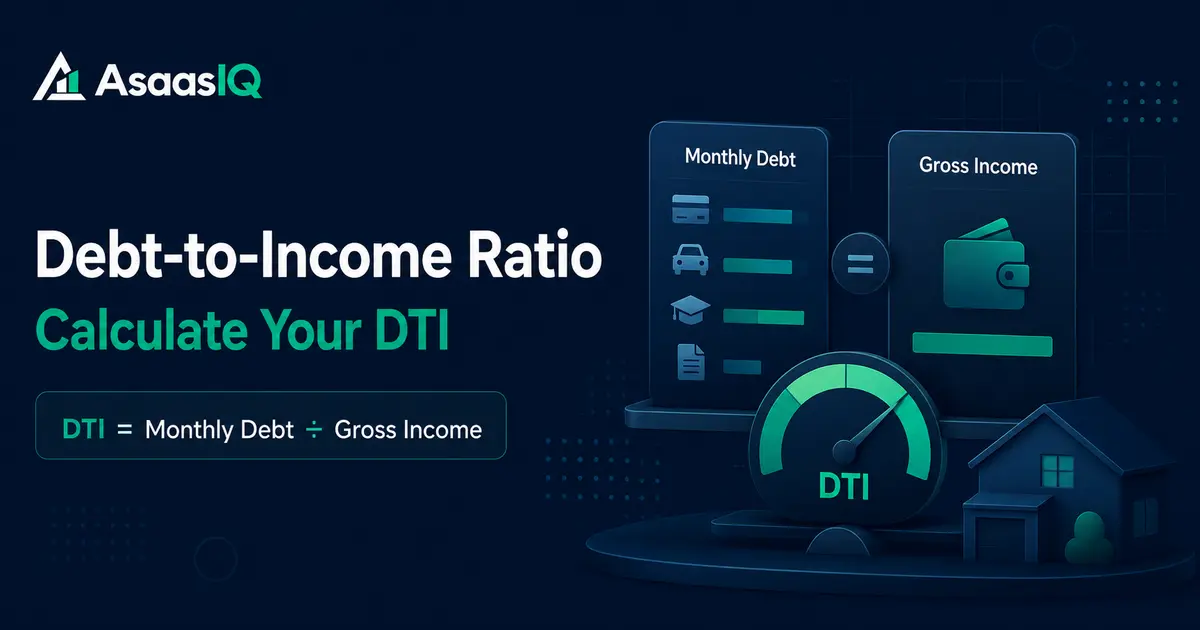
Your debt-to-income ratio, or DTI, compares required monthly debt payments with monthly income. If your monthly debt payments total 2,000 and your gross monthly income is 6,000, your DTI is 33.33%.
DTI formula:
Total monthly debt payments ÷ gross monthly income × 100
Lenders may use DTI to assess whether a borrower appears able to manage another payment. It is not a credit score, approval guarantee or complete measure of financial health.
How to calculate your debt-to-income ratio
Start with your gross monthly income and required monthly debt payments.
Income may include, when stable and acceptable to the relevant lender:
- Salary or wages before tax.
- Regular business or self-employment income.
- Pension or retirement income.
- Documented rental or investment income.
- Other recurring income the lender permits.
Debt-payment fields can include:
- Current or proposed housing payment.
- Car or vehicle loans.
- Student or education loans.
- Personal loans.
- Credit-card minimum payments.
- Court-ordered recurring obligations where applicable.
- Other required monthly debt payments.
From those two totals you can work out:
- Back-end DTI.
- Front-end housing ratio when housing is entered separately.
- Total monthly debt payments.
- Monthly income remaining before tax and ordinary expenses.
- DTI before and after a proposed new loan payment.
Treat any of this as a sensitivity check, not an approval prediction.
Quick DTI example
Housing payment:             1,500
Vehicle loan:                  100
Other monthly debt payments:   400
Total monthly debt:          2,000
Gross monthly income:        6,000

DTI = 2,000 ÷ 6,000 × 100
    = 33.33%
The Consumer Financial Protection Bureau uses the same basic relationship: add monthly debt payments and divide them by gross monthly income.
What is a debt-to-income ratio?
DTI is the percentage of monthly income committed to debt payments. It answers:
How much of the income used in this calculation is already assigned to required debt payments?
A lower DTI generally leaves more room for another payment, but lenders consider other information too. This can include credit history, assets, down payment, employment, income stability, loan type, interest rate, residual income and the proposed debt itself.
DTI is a narrower question than whether you can actually afford a loan comfortably, and narrower still than your overall financial picture — it measures lender affordability arithmetic, not your capacity to take on investment risk or progress toward financial independence. Different lenders, products and countries use different definitions and limits. A personal calculation provides an estimate; the lender's verified calculation controls an application.
The DTI formula
DTI (%) = total monthly debt payments ÷ gross monthly income × 100
Use monthly figures on both sides.
If income is quoted annually:
Gross monthly income = gross annual income ÷ 12
For annual income of 72,000:
72,000 ÷ 12 = 6,000 per month
If debt payments total 1,800:
1,800 ÷ 6,000 × 100 = 30% DTI
Do not divide total debt balances by annual income. DTI normally compares required periodic payments, not outstanding principal.
Gross income versus net income
Most consumer explanations of mortgage DTI use gross income, meaning income before taxes and payroll deductions. However, some products, jurisdictions or internal affordability assessments may use net income or another verified income measure.
The distinction matters:
Monthly debt payments: 1,500
Gross monthly income:  5,000 → DTI = 30%
Net monthly income:    4,000 → ratio = 37.5%
Label the denominator clearly. Do not call a net-income calculation "gross DTI."
For household budgeting, a net-income debt ratio can be useful because bills are paid from take-home income. For a formal application, follow the lender's requested method.
Front-end versus back-end DTI
Front-end DTI
Front-end DTI compares housing costs with gross monthly income:
Front-end DTI = monthly housing obligation ÷ gross monthly income × 100
Depending on the product and location, housing obligations may include:
- Proposed mortgage principal and interest.
- Property taxes.
- Homeowners or building insurance.
- Association or service charges.
- Required mortgage insurance.
Back-end DTI
Back-end DTI includes housing plus other required monthly debts:
Back-end DTI = all included monthly debt obligations ÷ gross monthly income × 100
Example:
| Item | Monthly amount |
|---|---|
| Proposed housing obligation | 1,400 |
| Vehicle loan | 350 |
| Student loan | 200 |
| Credit-card minimum | 100 |
| Total | 2,050 |
| Gross monthly income | 6,000 |
Front-end DTI = 1,400 ÷ 6,000 × 100 = 23.33%
Back-end DTI  = 2,050 ÷ 6,000 × 100 = 34.17%
When someone quotes a DTI without specifying the type, ask whether it is front-end or back-end.
What payments should be included?
Exact underwriting definitions vary, but a general estimate commonly considers required recurring payments such as:
- Mortgage or other housing debt.
- Proposed new housing payment.
- Vehicle financing.
- Student loans.
- Personal and instalment loans.
- Credit-card minimum required payments.
- Buy-now-pay-later obligations when treated as debt.
- Alimony, maintenance or child support where the lender requires it.
- Co-signed debt when the applicant remains liable, subject to lender rules.
Use the required monthly payment, not the amount you voluntarily choose to pay above the minimum. If a credit-card statement requires 100 but you usually pay 300, an underwriting calculation may use 100—although paying only the minimum can be expensive and is not necessarily good budgeting. If you're comparing the interest cost behind any of these payments, APR vs APY explains how the quoted rate relates to what you're actually paying.
What is normally excluded?
Traditional DTI often excludes ordinary living expenses that are not debt obligations, such as:
- Groceries.
- Utilities.
- Mobile and internet bills.
- Transport fuel.
- Routine insurance premiums not included in housing.
- Childcare.
- Subscriptions.
- Voluntary savings and investments.
Exclusion does not mean these costs are unimportant. A household can have a moderate DTI and still struggle because essential living expenses are high. That is why residual income and a complete budget matter.
Rent creates another common ambiguity. A mortgage affordability calculation may replace current rent with the proposed housing payment; another credit product may treat continuing rent as an obligation. Follow the lender's definition for the scenario you're modelling.
What is a good debt-to-income ratio?
There is no universal "good DTI" or approval cutoff. Lower generally indicates more unused monthly income, but acceptable levels depend on:
- Loan product.
- Lender and underwriting model.
- Country and regulation.
- Credit profile.
- Down payment or collateral.
- Income stability.
- Liquid savings and other assets.
- Interest rate and loan term.
- Residual income after essential expenses.
The CFPB explicitly notes that different lenders and loan products have different DTI limits. Treat any single number as a neutral data point, not an "approved," "safe" or "rejected" verdict — and link any product-specific threshold directly to current official rules, stating the jurisdiction and effective date.
Is 43% the maximum DTI?
No—not as a universal rule.
The number 43% appears frequently in older US mortgage explanations because an earlier version of the general Qualified Mortgage framework used it. Current US ability-to-repay rules do not prescribe one universal DTI threshold for every mortgage or lender; creditors may use their own documented standards and consider other relevant factors, subject to applicable rules.
Other mortgage programmes, non-mortgage lenders and countries have different approaches. Treat any article stating "43% is always the maximum" as oversimplified or potentially outdated.
This is exactly why the calculation should be shown separately from product eligibility.
DTI before and after a proposed loan
It helps to compare both current DTI and projected DTI side by side.
Suppose:
Gross monthly income:       7,000
Current monthly debt:       1,400
Proposed new loan payment:    500
Current DTI:
1,400 ÷ 7,000 × 100 = 20%
Projected DTI:
(1,400 + 500) ÷ 7,000 × 100 = 27.14%
This helps a user understand the payment's effect without predicting approval.
How much additional monthly debt reaches a target DTI?
For scenario planning:
Maximum total payment at target DTI
= gross monthly income × target DTI
Then:
Additional payment room
= maximum total payment − current monthly debt payments
If gross income is 6,000, current debt payments are 1,200 and the user wants to model 35%:
6,000 × 0.35 = 2,100 total payment
2,100 − 1,200 = 900 additional payment room
This is only arithmetic. It is not a recommendation to borrow 900 or evidence that a lender will approve it. Taxes, household expenses and financial goals may make a much smaller payment appropriate.
Does DTI affect your credit score?
DTI and credit score are different measurements.
Credit scores are generally calculated from credit-report information, while income is not normally part of a standard consumer credit report. Therefore, the DTI percentage itself is not typically a direct credit-scoring input.
However, the debts behind DTI can affect credit reports and scores through:
- Payment history.
- Outstanding balances.
- Credit utilisation.
- Account age and mix.
- New credit applications.
Lenders may consider both DTI and credit information separately.
DTI versus credit utilisation
| Metric | Formula | Primary purpose |
|---|---|---|
| DTI | Monthly debt payments ÷ monthly income | Measures payment burden relative to income |
| Credit utilisation | Revolving balances ÷ revolving credit limits | Measures use of available revolving credit |
Someone can have low utilisation but high DTI because of mortgage, vehicle or student-loan payments. Another person can have low DTI but high utilisation on a small credit-card limit.
Do not substitute one metric for the other.
DTI versus debt-service ratio
Terminology varies internationally. Some lenders use terms such as:
- Debt-service ratio.
- Total debt-service ratio.
- Gross debt-service ratio.
- Payment-to-income ratio.
- Loan-to-income ratio.
- Fixed-obligation-to-income ratio.
These are not always identical to US-style DTI. They may use net income, annual balances, stress-tested payments or prescribed expense assumptions. Use clear labels rather than assuming every country uses one standard.
Irregular, self-employed and joint income
Irregular income
Do not automatically use the highest recent month. Lenders may average income across a required period and exclude income that is not expected to continue.
Self-employment income
Business revenue is not the same as personal qualifying income. Expenses, tax documents and lender adjustments can materially change the amount used.
Joint applications
If two people apply together, combine only the income and obligations the lender includes. Joint liabilities, individual debts and co-signed accounts may be treated differently.
Currency
Income and debt payments must use the same currency and period. If income is earned in one currency and debt is payable in another, exchange-rate risk can make a static DTI misleading.
How to lower DTI
The formula offers only two direct paths: reduce included monthly debt payments or increase qualifying income. Practical options can include:
- Pay off a small instalment loan, if doing so does not exhaust emergency savings you'd need to draw on before your next paycheque.
- Reduce revolving debt and required minimum payments.
- Avoid taking on new debt before an application.
- Document stable income accurately.
- Consider a smaller loan or less expensive purchase.
- Extend a loan term only after considering the higher total interest and longer obligation.
- Review inaccurate debt records through the proper reporting process.
Do not refinance or consolidate solely to improve a ratio. A lower monthly payment can increase total interest, fees or repayment time.
DTI is not a household budget
A lender's DTI asks whether required debt payments fit a defined income measure. A household budget asks whether all expenses and goals fit actual take-home income.
A responsible personal assessment also includes:
- Taxes and payroll deductions.
- Food, utilities and transport.
- Healthcare and insurance.
- Dependants and education.
- Emergency savings.
- Retirement contributions.
- Irregular and annual expenses.
- Expected changes in income or interest rates.
Residual income—the money left after obligations and essential expenses—may reveal pressure that DTI alone misses.
DTI in Excel and Google Sheets
If total monthly debt payments are in B2 and gross monthly income is in B3:
=B2/B3
Format the result as a percentage.
If annual gross income is in B3:
=B2/(B3/12)
For projected DTI with a new monthly payment in B4:
=(B2+B4)/B3
For additional payment room at a target DTI in B5:
=MAX(0,B3*B5-B2)
Use B3/12 in the last two formulas if B3 contains annual rather than monthly income.
Common DTI mistakes
- Dividing debt balances by income instead of monthly payments.
- Mixing annual income with monthly payments.
- Using net income while labelling it gross income.
- Excluding the proposed new payment.
- Counting the same housing payment twice.
- Using voluntary extra payments instead of required minimums without explanation.
- Assuming one lender's threshold applies everywhere.
- Treating 43% as a universal current maximum.
- Ignoring taxes and living costs because they are outside formal DTI.
- Using unstable income without a defensible averaging method.
- Entering income and payments in different currencies.
Frequently asked questions
How do I calculate my debt-to-income ratio?
Add the monthly debt payments included in your scenario, divide the total by gross monthly income and multiply by 100. For example, 1,500 divided by 5,000 equals 30%.
Is rent included in DTI?
It depends on the loan, lender and scenario. Mortgage calculations may replace current rent with the proposed housing payment, while another affordability assessment may include continuing rent. Check the applicable definition.
Are utilities included in DTI?
Utilities are usually treated as living expenses rather than debt payments in a traditional DTI calculation. They still affect affordability and should appear in a household budget.
Do credit-card balances or minimum payments count?
DTI generally uses required monthly payments rather than the entire balance. Lender rules determine the payment used when a statement has no clear minimum or the account is paid in full.
Is a lower DTI always better?
A lower payment burden generally provides more flexibility, but DTI does not measure investment assets, emergency savings, credit history or life circumstances. It is one input, not a complete financial score.
Can I calculate DTI with net income?
You can calculate a personal net-income ratio, but label it clearly. If a lender requests gross income, a net-income result will not match its DTI.
Will a calculator tell me whether I qualify for a mortgage?
No. Qualification depends on lender verification, product rules, credit, assets, property, income, rates and other factors. This is an estimate of the ratio from the information you provide, not an eligibility decision.
Bottom line
Debt-to-income ratio is simple arithmetic with important definitions:
DTI = monthly debt payments ÷ gross monthly income × 100
Use payments rather than balances, keep periods and currencies consistent, identify front-end or back-end DTI, and include the proposed payment when relevant. Most importantly, do not turn the result into a universal approval verdict.
Sources & References
Educational information only
AsaasIQ provides general educational content about investing in Pakistan. Nothing on this site is personalized financial, tax, legal or investment advice. AsaasIQ is not a financial advisor, broker, asset management company or affiliate of the Pakistan Stock Exchange. Always verify current facts, rates and regulations with official sources before acting.

Founder and Editor, AsaasIQ
Software engineer and the founder of AsaasIQ. Not a licensed financial adviser -- every article is educational and source-linked.
Published August 2026 · Last reviewed August 2026