Understanding ETFs in Pakistan
An introduction to Exchange-Traded Funds (ETFs) as they exist in Pakistan's market — how they work, how they differ from mutual funds, and what to check before investing.
If you've spent time reading about US or European markets, you've probably noticed ETFs mentioned constantly — they're a massive part of how people invest in those markets. In Pakistan, the picture looks different. ETFs exist here too, but they occupy a much smaller, newer corner of the investment landscape than mutual funds do. That doesn't make them unimportant, but it does mean the usual global commentary on ETFs doesn't map perfectly onto Pakistan's market yet.
Let's get into what an ETF actually is, and more importantly, how it differs from the mutual fund structure most Pakistani investors are already somewhat familiar with.
The basic idea behind an ETF
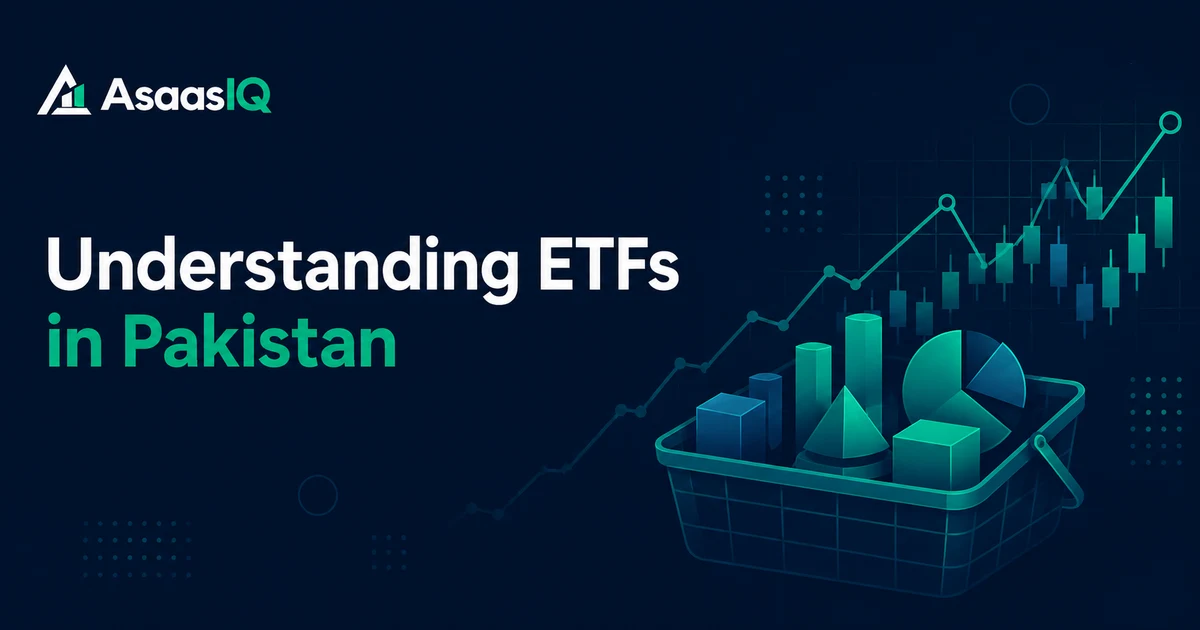
An Exchange-Traded Fund is a fund that holds a basket of underlying assets — commonly a group of stocks designed to track a specific index — but unlike a traditional mutual fund, it's listed and traded directly on the stock exchange, the same way an individual company's shares are.
That single distinction changes a lot about how you interact with it. You buy and sell ETF units through your brokerage account, during regular trading hours, at whatever price the market is currently offering. You're not transacting with the fund company at one fixed daily price the way you would with a typical open-end mutual fund — you're trading with other market participants in real time, just like you would with any listed stock.
Where ETFs and mutual funds actually diverge
It's easy to lump ETFs and mutual funds together as "basically the same thing, diversified funds," but the mechanics differ enough to matter:
| Factor | ETF | Traditional Open-End Mutual Fund |
|---|---|---|
| Where it trades | On the stock exchange, like a company's shares | Directly through the AMC |
| Pricing | Continuous market price during trading hours | Usually one NAV calculated per day |
| How you transact | Through a brokerage account | Through the AMC or its distributors |
| Typical management style | Often passive, tracking an index | Can be actively or passively managed |
Because an ETF trades continuously on an exchange, its market price can, in theory, drift slightly away from the actual value of what it holds during the trading day — supply and demand for the ETF itself can push the price around a bit. In well-developed ETF markets, mechanisms exist to keep this gap small, but it's worth knowing the gap can technically exist at all, which isn't really a concept that applies to daily-NAV mutual funds.
Why someone might choose an ETF
Diversification in a single transaction. Buying one ETF unit can give you exposure to dozens of underlying companies at once — a meaningful shortcut compared to buying each company's shares individually.
More transparency than you might expect. Index-tracking ETFs generally publish their holdings, since the whole point is mirroring a known, published index. You can usually see exactly what you own.
Trading flexibility. Because ETFs trade on the exchange during market hours, you can buy or sell whenever the market is open — a different rhythm than waiting for a mutual fund's once-daily NAV cycle.
What to actually check before buying one
What is it tracking, precisely? "ETF" isn't a strategy by itself — it's a wrapper. Understand exactly which index or strategy the specific ETF is designed to replicate before assuming you know what you're buying.
How liquid is it, really? In a smaller, newer market, some ETFs may trade thinly — meaning fewer buyers and sellers active at any given moment. Thin trading can make it harder to buy or sell at a price close to the ETF's actual underlying value, especially for larger trade sizes.
What's the total expense ratio? Even a passively managed, index-tracking ETF charges a fee. It's usually lower than an actively managed fund's fee, but it's never zero, and it compounds against your returns just like any other cost.
How closely does it actually track its index? This is called tracking difference, and it measures how well the ETF's real-world performance matches its stated benchmark. A poorly managed ETF can drift from its target over time even while claiming to track it.
The specific ETFs available on the PSX — how many exist, what they track, their current fees — changes as the market develops and new products launch. Rather than listing specifics that would age poorly, the right move is checking the PSX website directly, or the documentation published by the ETF's managing AMC, for whatever's currently available.
Shariah-compliant ETFs
As with mutual funds, some ETFs are built to be Shariah-compliant, screening out companies or sectors that don't meet Islamic investing principles. If this matters to you — and for a meaningful share of Pakistani investors, it does — don't assume compliance just because a fund's name suggests it. Look for the specific screening methodology and the Shariah advisory board disclosed in the ETF's official documentation. Names can be marketing; documentation is where the actual screening criteria live.
The honest boundary of this article
This piece explains what an ETF is and how it generally differs from a mutual fund. It deliberately doesn't list, recommend, or evaluate any specific PSX-listed ETF, because the available products, their holdings, and their fees shift over time in ways a static article can't keep pace with. Before investing in any ETF, read its current official documentation — available through the PSX or the managing AMC — rather than relying on a general overview like this one.
Sources & References
Educational information only
AsaasIQ provides general educational content about investing in Pakistan. Nothing on this site is personalized financial, tax, legal or investment advice. AsaasIQ is not a financial advisor, broker, asset management company or affiliate of the Pakistan Stock Exchange. Always verify current facts, rates and regulations with official sources before acting.

Founder and Editor, AsaasIQ
Software engineer and the founder of AsaasIQ. Not a licensed financial adviser -- every article is educational and source-linked.
Published August 2026 · Last reviewed August 2026