PSX Taxes and Charges in Pakistan: CGT, Dividends and Fees 2026
Understand PSX capital gains tax, dividend withholding tax, brokerage commission and market levies—and calculate the difference between gross and net return.
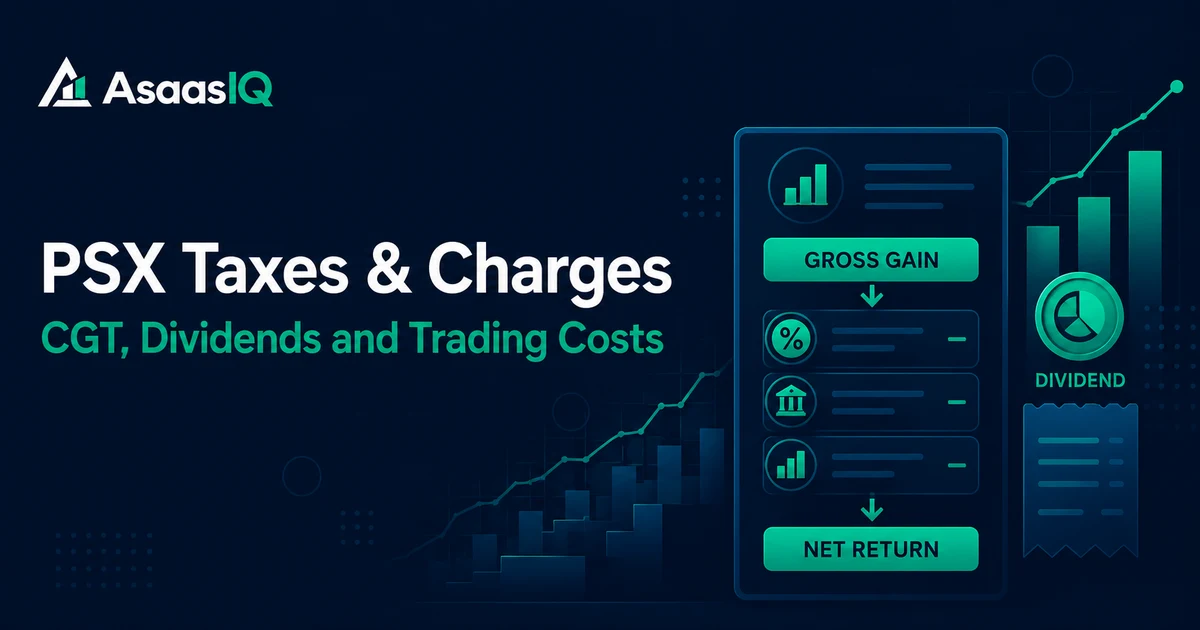
A profitable share trade does not mean the full price difference reaches your pocket. An investor may pay brokerage commission, regulatory and settlement levies, taxes on brokerage services, capital gains tax when a gain is realised, and withholding tax when a dividend is paid.
The result that matters is the net return after costs and taxes, not the percentage change shown on a price chart.
Quick answer: For a PSX investor, trading costs normally include the broker's commission plus applicable PSX, NCCPL, CDC, SECP and government levies. Capital gains tax applies to realised gains under rules that depend on acquisition date and tax status. For Tax Year 2027, ordinary dividends generally carry 15% withholding for investors on the Active Taxpayers List (ATL) and 30% for non-ATL investors, with different rates for specified categories. Always use the tariff schedule and contract note from your broker for exact transaction costs.
This guide was last verified on 14 August 2026. Tax law is date-sensitive, and this article is educational rather than personalised tax advice.
The five layers between gross and net return
| Layer | Trigger | Where to verify it |
|---|---|---|
| Brokerage commission | Buy or sell order is executed | Broker's signed or digitally accepted tariff schedule |
| Market and settlement levies | Transaction, clearing, settlement or custody activity | Contract note and current PSX/NCCPL/CDC schedules |
| Tax on services or duties | Applied to taxable brokerage or related services | Contract note and applicable provincial/federal rules |
| Capital gains tax (CGT) | A taxable gain is realised on disposal | NCCPL CGT computation/certificate and tax law |
| Dividend withholding tax | A company or fund pays a distribution | Dividend advice, CDC record and FBR rate card |
These items do not all use the same base. A commission may be based on trade value, CGT on a calculated gain, and dividend withholding on the dividend amount.
Brokerage commission is not a universal PSX rate
The broker charges commission for executing the trade. The rate, minimum charge and tax treatment can differ by broker, market and customer agreement — one more reason to compare brokers directly rather than assume a single market-wide rate, as covered in How to Open a Brokerage Account in Pakistan.
PSX requires brokers to give customers a tariff schedule containing:
- Commission and other broker charges.
- Regulatory levies such as PSX, CDC, NCCPL and SECP charges.
- Applicable statutory taxes and duties.
Your broker must also provide a contract note for executed trades. It should identify the security, quantity, price, commission and applicable levies.
This means an online claim such as "PSX charges are exactly X%" is usually incomplete. Ask for the current all-in tariff illustration for both a buy and a sell of the amount you expect to trade.
Market, clearing, settlement and custody charges
Pakistan's capital-market infrastructure separates several functions — see What Is the Pakistan Stock Exchange? for how these pieces fit together if the roles below aren't already familiar:
- PSX operates the exchange and trading framework.
- NCCPL performs clearing, settlement and related functions, including the CGT regime for covered transactions.
- CDC provides depository and custody infrastructure.
- SECP regulates the market.
Charges associated with these functions can appear as separate lines or be grouped in the broker's statement. The amount can depend on the security, market, quantity, value and current schedules.
Pakistan moved eligible PSX trades to a T+1 settlement cycle on 9 February 2026. T+1 means settlement generally occurs one business day after the trade date; it does not mean every tax or fee is charged one day later.
Do not copy old fee percentages into a calculator without a source and effective date. Build the calculation from the broker's current contract note.
Capital gains tax applies to realised gains
A capital gain generally arises when a security is disposed of for more than its recognised cost after applying the relevant tax rules.
A price increase while you still hold the share is an unrealised gain. It can improve your portfolio value, but the PSX CGT mechanism is concerned with disposal and the computed taxable gain.
A simple educational starting point is:
Gross realised gain = sale proceeds − purchase cost
Indicative CGT = taxable capital gain × applicable CGT rate
The actual NCCPL calculation can account for transaction records, eligible costs, losses, tax-law rules and adjustments. Do not treat the simple formula as a substitute for the official computation.
Headline PSX CGT rates by acquisition period
The acquisition date matters. The table below summarises the current structure displayed by NCCPL for listed securities. It is not a complete tax opinion.
| When the security was acquired | Headline treatment shown for ATL investors |
|---|---|
| Before 1 July 2013 | 0% |
| 1 July 2013 to 30 June 2022 | 12.5% |
| 1 July 2022 to 30 June 2024 | Holding-period rates may reduce from 15% to 0% |
| 1 July 2024 to 30 June 2025 | 15% |
| On or after 1 July 2025 | 15% |
For securities acquired from 1 July 2022 to 30 June 2024, NCCPL's schedule shows these ATL rates:
| Holding period | ATL rate shown by NCCPL |
|---|---|
| Up to one year | 15% |
| More than one year to two years | 12.5% |
| More than two years to three years | 10% |
| More than three years to four years | 7.5% |
| More than four years to five years | 5% |
| More than five years to six years | 2.5% |
| More than six years | 0% |
A caution for non-ATL investors
Do not assume the ATL percentage is your rate. Tax legislation and summaries can apply enhanced, normal-slab or minimum-rate treatment to non-ATL cases depending on the acquisition period and taxpayer type. NCCPL's current online presentation and statutory interpretations should be checked together for the relevant tax year.
If you are not on the ATL—or if the amount is material—obtain a current computation from NCCPL, your broker or a qualified Pakistani tax professional rather than relying on a generic calculator.
Who calculates and collects PSX CGT?
NCCPL calculates, determines, collects and deposits CGT for covered capital-market transactions under the applicable regime. It also issues an annual CGT certificate, which NCCPL describes as conclusive evidence of the capital gain and tax calculated through the system.
Investors should retain:
- Monthly CGT reports.
- Annual CGT certificate.
- Broker contract notes and ledger.
- CDC account or sub-account statements.
- Bank statements for deposits and withdrawals.
- Dividend and corporate-action records.
Automatic collection does not necessarily complete every personal return or wealth-statement obligation. Your wider tax position can require information beyond the amount deducted through the market system.
Can capital losses reduce capital gains?
NCCPL's computation may net eligible gains and losses according to the applicable rules and period. That is one reason the tax on a monthly report may differ from applying 15% to one profitable sale in isolation.
However, loss treatment, carry-forward rules and adjustments are legal questions with conditions. Use the official CGT statement and professional advice for your circumstances.
Dividend withholding tax in Tax Year 2027
Dividends are different from capital gains. A dividend is a distribution; tax is generally withheld when it is paid — see How Dividends Affect Your Total Investment Return for how that distribution fits into your overall return alongside price change.
FBR's Tax Year 2027 withholding rate card, updated through the Finance Act 2026, shows:
| Dividend category | ATL rate | Non-ATL rate |
|---|---|---|
| Independent power purchasers in the specified pass-through case | 7.5% | 15% |
| REIT and ordinary cases not covered by a special category | 15% | 30% |
| Mutual-fund distribution attributable to equity income | 15% | 30% |
| Mutual-fund distribution attributable to debt income | 25% | 50% |
The classification matters. Do not apply the general 15% rate automatically to every distribution.
Dividend example
Assume an ATL investor receives a PKR 10,000 ordinary dividend to which the 15% rate applies:
Gross dividend                         PKR 10,000
Withholding tax at 15%                PKR  1,500
Net amount before any other adjustment PKR 8,500
For a non-ATL investor in the ordinary 30% category, the same simplified calculation would leave PKR 7,000. This example does not cover special dividend categories, zakat, investor-specific tax treatment or later return adjustments.
A worked trade example: from price gain to net result
Assume an ATL individual buys shares for PKR 100,000 and later sells them for PKR 112,000. The shares fall in a 15% CGT category.
Let the combined buy-side costs be PKR 300 and sell-side costs be PKR 340. These cost figures are hypothetical because actual broker tariffs and levies vary.
Sale value                              PKR 112,000
Purchase value                          PKR 100,000
Gross price gain                        PKR  12,000
Less: assumed buy and sell costs        PKR     640
Illustrative gain before CGT            PKR  11,360
Illustrative CGT at 15%                 PKR   1,704
Illustrative net gain                   PKR   9,656
The chart return is 12%, but the illustrative net gain is about 9.66% of the original PKR 100,000 after the assumed costs and CGT.
This is not an NCCPL calculation. The recognised cost base, fee treatment, loss netting and timing can change the official result.
What your contract note should tell you
PSX's Investor Awareness Guide says a contract note should include information such as:
- Execution date.
- Security name and quantity.
- Market and trade type.
- Execution price.
- Commission and other charges.
- Regulatory levies.
- Statutory taxes and duties.
- Whether the broker acted for its own account or from the market.
Compare the contract note with the order you placed. Ask the broker about any abbreviation or amount you cannot explain.
How to calculate your true investment return
For an investment with both a sale and dividends, a useful framework is:
Net ending value = sale proceeds
                 + net cash dividends
                 − buy costs
                 − sell costs
                 − capital gains tax
                 − other applicable deductions

Net return % = (net ending value − original cash invested)
               ÷ original cash invested × 100
If dividends were reinvested, track the additional units or shares and their purchase costs. The Dividend Income Calculator can model the reinvestment concept, but actual results require the real dividend, price, tax and fee data.
For a historical comparison, use the CAGR Calculator — but remember it works from price growth alone, so it won't reflect dividends, transaction costs or taxes unless you build those into the numbers you feed it. A price-only answer is not a total-return answer.
ATL status can materially affect net income
The Active Taxpayers List is not merely a label used by brokers. It can change withholding rates and other tax treatment.
Check your ATL status through FBR's official service and resolve filing questions with a qualified professional. Do not enter someone else's NTN or assume that filing a return instantly updates every system.
The relevant status date and system update can matter when a dividend or transaction is processed.
What about zakat?
Zakat is separate from CGT, dividend withholding and brokerage charges. Its deduction can depend on the account or security, the applicable law, declarations and the investor's circumstances.
If zakat applies to you, verify the treatment with CDC, the broker, the company or fund and a knowledgeable adviser. Do not hide it inside a generic "tax" percentage.
Common calculation mistakes
Using the chart's percentage as your return
Price appreciation excludes transaction costs and may exclude dividends and corporate actions.
Charging CGT on the full sale value
CGT is a tax on a calculated gain, not simply 15% of all sale proceeds.
Applying one rate to every acquisition date
PSX CGT uses acquisition-date regimes. Older holdings can have different treatment.
Assuming every dividend is taxed at 15%
Special company and mutual-fund categories can have different rates.
Ignoring non-ATL treatment
An example written for an ATL individual may not apply to a non-ATL investor or a company.
Treating all broker charges as commission
Commission, regulatory levies and statutory taxes should be identified separately where possible.
Using an old blog or screenshot
Tax laws, settlement cycles and tariff schedules change. Always check the effective date.
Investor record-keeping checklist
- Current broker tariff schedule.
- Daily contract notes.
- Broker cash and securities ledger.
- CDC statements or alerts.
- NCCPL monthly CGT reports.
- NCCPL annual CGT certificate.
- Dividend advices and corporate-action records.
- Bank deposit and withdrawal evidence.
- FBR return and wealth-statement working papers.
Frequently asked questions
Is PSX capital gains tax always 15%?
No. Fifteen percent is a common headline rate for current ATL acquisitions, but acquisition date, holding period, ATL status and investor type can change the treatment.
Is CGT charged when a share price rises?
An unsold price increase is unrealised. CGT under the PSX mechanism concerns a taxable gain on disposal, calculated under the applicable rules.
Does the broker deduct CGT?
NCCPL administers the CGT computation and collection mechanism for covered transactions. Your broker's statements may show related entries, but the NCCPL CGT reports and certificate are key records.
How much commission does a PSX broker charge?
There is no single customer commission rate that applies to every broker and trade. Obtain the broker's tariff schedule and compare the all-in cost, including minimum charges and levies.
Are dividends tax-free in Pakistan?
Generally no. Dividend withholding depends on the dividend category and ATL status. FBR's Tax Year 2027 rate card shows 15% for many ordinary ATL cases and 30% for corresponding non-ATL cases, with special categories at other rates.
Can I use this article to file my tax return?
No. Use official statements and current law, and consult a qualified Pakistani tax professional when needed. This guide explains the structure but cannot determine your complete tax position.
Final takeaway
A return calculator becomes useful only when it distinguishes price change from money the investor actually keeps.
For every PSX investment, record the purchase cost, sale proceeds, dividends, broker commission, market levies and official tax deductions. Use the broker's tariff schedule and contract note for transaction costs, NCCPL for CGT records, and FBR for current withholding rates.
The cleanest question is not "How much did the share rise?" It is "What was my net return after every cash flow?"
Sources & References
Educational information only
AsaasIQ provides general educational content about investing in Pakistan. Nothing on this site is personalized financial, tax, legal or investment advice. AsaasIQ is not a financial advisor, broker, asset management company or affiliate of the Pakistan Stock Exchange. Always verify current facts, rates and regulations with official sources before acting.

Founder and Editor, AsaasIQ
Software engineer and the founder of AsaasIQ. Not a licensed financial adviser -- every article is educational and source-linked.
Published August 2026 · Last reviewed August 2026