How to Invest in Pakistan T-Bills Through InvestPak (2026)
Learn how Pakistan Treasury Bills work and how to buy them through InvestPak, including IPS accounts, bidding, yields, taxes, risks and examples.
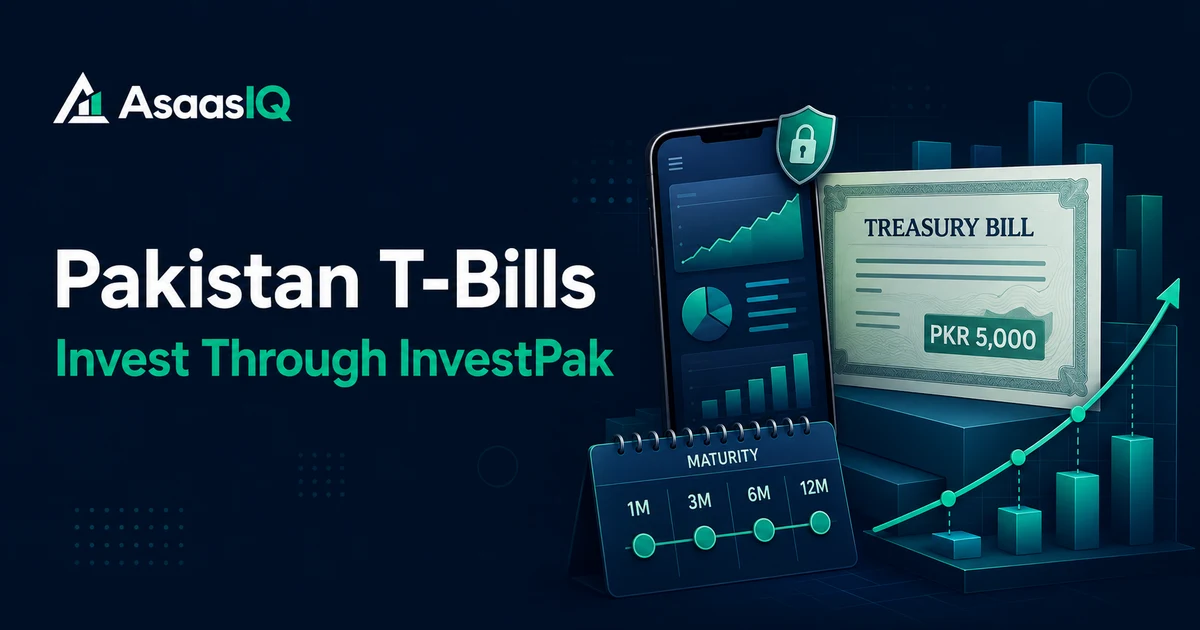
Pakistanis no longer have to assume that Treasury Bills are only for banks and large institutions. The State Bank of Pakistan's InvestPak platform lets eligible bank customers digitally request an Investor Portfolio Securities account, submit bids in government-security auctions and request secondary-market transactions.
The access has become easier. The product still needs explanation.
A T-bill does not pay monthly "profit" like a savings account. You normally buy it below its face value and receive the face value at maturity. Your return depends on the accepted price, days to maturity, taxes, bank charges and whether you hold or sell early.
Quick answer: A Pakistani individual with a PKR bank account can register on InvestPak, request an IPS account through a linked financial institution, select a Market Treasury Bill tenor, submit a competitive or non-competitive bid, and fund an allotted purchase. The official InvestPak product page currently lists a PKR 5,000 minimum denomination and no maximum.
Information in this guide was checked against SBP and InvestPak sources on 16 August 2026. Auction yields and schedules change; use the portal's current auction result and calculator before bidding.
What is a Treasury Bill in Pakistan?
A Market Treasury Bill—usually shortened to MTB or T-bill—is a short-term conventional debt security issued by the Government of Pakistan.
InvestPak lists four active tenors:
- 28 days, commonly called one month.
- 84 days, commonly called three months.
- 182 days, commonly called six months.
- 364 days, commonly called twelve months.
T-bills are zero-coupon securities. There is no periodic coupon payment. Instead, an investor generally pays a discounted amount now and receives the face value at maturity.
If the face value is PKR 100,000 and the accepted purchase price is PKR 97,500, the gross rupee gain at maturity is PKR 2,500:
Gross gain = maturity value − purchase price
           = PKR 100,000 − PKR 97,500
           = PKR 2,500
That PKR 2,500 should not automatically be described as a 2.5% annual return. The holding period is shorter than a year, and money-market yields use specific pricing and day-count conventions. InvestPak states an Act/365 convention and provides a financial calculator.
T-bill facts at a glance
| Feature | InvestPak information |
|---|---|
| Issuer | Government of Pakistan |
| Instrument type | Conventional, zero-coupon security |
| Active tenors | 28, 84, 182 and 364 days |
| Minimum denomination | PKR 5,000 |
| Investment multiples | PKR 5,000 |
| Maximum | No stated limit |
| Return | Fixed to maturity after purchase/allotment |
| Auction frequency | Fortnightly |
| Primary-market route | Competitive or non-competitive auction bid |
| Secondary market | Buy/sell quote requested through linked institution |
| Custody record | Investor Portfolio Securities account |
| Tax | According to applicable law |
The minimum denomination is not the same as a guarantee that every bank will offer an identical customer experience or fee schedule. Confirm operational minimums and charges with the linked institution.
What is InvestPak?
InvestPak is an SBP platform for digital access to Government of Pakistan securities. SBP formally launched the platform's web and mobile access in July 2026 after the portal became operational in late 2025.
It enables investors to:
- Register using a PKR bank account and IBAN.
- Request an IPS account digitally.
- Link multiple eligible PKR and IPS accounts.
- Submit bids in primary auctions.
- Request bank quotes in the secondary market.
- View holdings and transactions in a unified portfolio.
- Access auction calendars, results, daily reference yields and calculators.
InvestPak is the interface. Your bank or other participating financial institution still performs onboarding, maintains the linked accounts and executes relevant transactions.
What is an IPS account?
An Investor Portfolio Securities account records an investor's government securities. Think of it as the custody account for T-bills, PIBs or other eligible government instruments—not a wallet that replaces your bank account.
You generally need:
- A PKR account with a participating financial institution.
- An IPS account linked to that institution.
- Sufficient cleared money in the linked account when payment is required.
If you do not already have an IPS account, InvestPak lets you request one during registration. Your institution conducts identity, compliance and account checks. A successful portal registration should not be confused with an accepted auction bid.
Who can invest through InvestPak?
InvestPak states that individuals and corporates with bank accounts are eligible to invest in Pakistan government securities. The digital onboarding framework includes individual and joint-account holders using PKR accounts and IBANs.
Eligibility does not guarantee that every account type at every institution is already enabled. Before transferring a large balance, verify:
- Your bank appears as an available institution in the portal.
- Your account title, CNIC and mobile details match bank records.
- The account can be linked for IPS settlement.
- You understand the institution's charges and cut-off time.
Non-resident investors should check whether the resident InvestPak route or a Roshan Digital Account route applies to their money and repatriation needs. Do not send foreign funds into a structure without confirming foreign-exchange rules.
How to buy T-bills through InvestPak: step by step
Step 1: prepare your bank details
Have your CNIC, registered mobile/email and PKR IBAN ready. Resolve spelling, mobile-number or account-status problems with the bank first.
Step 2: register on the official portal or app
Use the official domain investpak.sbp.org.pk or the app link published by SBP. Avoid links sent by strangers or sponsored pages imitating the portal.
Create the profile and select the financial institution holding your PKR account.
Step 3: request or link an IPS account
Submit an IPS-opening request if you do not have one. The financial institution reviews onboarding. Save the confirmation and note any disclosed schedule of charges.
Step 4: study the auction calendar
T-bill auctions do not occur whenever a buyer feels like purchasing. InvestPak publishes the official calendar showing auction and settlement dates.
Work backwards from settlement. Money should be cleared in the linked account before the institution's cut-off; a transfer initiated at the last minute can miss the auction.
Step 5: choose a tenor
Match the bill to the date you expect to need the money:
- A 28-day bill for very short known needs.
- An 84-day bill for roughly three months.
- A 182-day bill for roughly six months.
- A 364-day bill for roughly one year.
Do not choose the longest tenor merely because its displayed yield is higher. Selling before maturity introduces price and execution risk.
Step 6: choose competitive or non-competitive bidding
This is the most important decision in the form.
With a competitive bid, you specify a desired yield or price. If your bid is outside the accepted auction range, it can be rejected. Multiple competitive bids are permitted under the published product rules.
With a non-competitive bid, you ask for allotment at the uniform price determined under the auction process rather than naming your own yield. InvestPak says eligible non-bank investors may submit one non-competitive bid per tenor; multiple NCBs can cause all of them to be cancelled. An upper limit linked to the auction target also applies.
For a beginner who wants market-determined execution rather than forecasting the cut-off, the non-competitive route may be simpler—but it does not guarantee allotment or a particular return. Read the live auction screen before confirming.
Step 7: enter the face value carefully
T-bills are quoted around face value and discount price. Confirm whether the portal field asks for face value, bid amount, price or yield. Entering PKR 100,000 face value does not necessarily mean PKR 100,000 will leave the account; the discounted settlement amount may differ.
Step 8: review and submit
Check:
- Security and tenor.
- Competitive versus non-competitive type.
- Face value.
- Yield/price if competitive.
- Auction date and settlement date.
- Linked bank and IPS account.
- Funding requirement.
- Charges and tax disclosures.
Keep the submission reference. A submitted bid is not the same as an allotment.
Step 9: check the result and settlement
After the auction, review the official result and your allotment. Ensure sufficient cleared funds. The allotted security should appear in the IPS portfolio after settlement under the applicable process.
Step 10: hold to maturity or request a sale
If held to maturity, the face value is settled according to the account arrangement. If you need money early, request a secondary-market quote through the linked institution. Review the actual sale proceeds before accepting.
Competitive versus non-competitive bids
| Question | Competitive bid | Non-competitive bid |
|---|---|---|
| Do you specify yield/price? | Yes | No; auction-determined uniform price applies |
| Can pricing judgment cause rejection? | Yes | Not in the same way, although allotment is not guaranteed |
| Multiple bids per tenor? | InvestPak permits multiple CBs | One NCB; multiple submissions can cancel all NCBs |
| Best suited to | Investors who understand auction pricing | Investors seeking simpler market-based participation |
"Non-competitive" does not mean "no risk," "best rate" or "instant purchase." It describes the auction instruction.
How T-bill yield and price work
Price and yield move in opposite directions. For the same maturity amount, a lower purchase price produces a higher return.
Suppose an illustrative 84-day bill has:
- Face value: PKR 100,000.
- Settlement price: PKR 97,400.
- Gross maturity gain: PKR 2,600.
The simple holding-period gain relative to cash paid is:
PKR 2,600 ÷ PKR 97,400 = 2.669%
Annualising it by merely multiplying by four would be imprecise. The actual tenor is 84 days, not exactly one quarter, and official market conventions matter. Use InvestPak's calculator for price/yield conversion.
Cut-off yield is not your bank deposit rate
The auction result's cut-off yield is a market quotation. Your realised result can differ because of:
- The exact accepted price.
- Competitive versus non-competitive allocation.
- Days from settlement to maturity.
- Withholding and final tax treatment.
- IPS, transaction or service charges.
- Selling before maturity.
Do not compare a gross auction yield with a savings account's after-tax cash return without adjustment.
What happens if you sell before maturity?
T-bills are marketable. A bank can quote a secondary-market purchase price, but the price can be above or below what you paid.
If market yields have risen since purchase, the price of an existing bill usually falls. If yields have fallen, its price usually rises. Short maturities generally reduce price sensitivity compared with long bonds, but do not eliminate it.
You also face:
- The bank's bid/offer spread.
- Available market liquidity.
- Settlement timing.
- Transaction charges.
If the money may be needed tomorrow, a savings account or appropriately liquid fund may fit better than relying on an early T-bill sale — which is exactly why keeping an emergency fund separate from money locked into a fixed tenor matters.
Tax on Pakistan T-bills
InvestPak correctly states that tax applies according to current law rather than publishing one permanent percentage on the product page.
T-bill gains are generally treated within Pakistan's profit-on-debt framework, but the withholding and final liability can depend on taxpayer status, investor type, the relevant tax year and legal classification. Finance Acts can change the rate.
Before bidding, obtain from your bank:
- The current ATL and non-ATL withholding treatment.
- Whether the tax is adjustable or final for your case.
- The tax certificate/reporting process.
- Treatment of a secondary-market sale.
Use the current FBR withholding-tax rate card or a qualified tax adviser. Do not rely on an old rate without an effective date and legal source.
Are T-bills safe?
T-bills are sovereign obligations of the Government of Pakistan and are commonly treated as carrying low credit risk in PKR terms. "Government security" does not mean "no risk" — the risks below are worth weighing against your own capacity for risk before committing money to a fixed tenor.
Inflation risk
If inflation exceeds the after-tax return, purchasing power can fall even though the maturity value is received.
Reinvestment risk
A three-month bill can mature when new yields are much lower. Today's annualised yield is not locked for years.
Market-price risk
Selling before maturity can produce less than expected.
Sovereign and currency risk
The obligation is in Pakistani rupees. It does not protect the investor's value in dollars, euros or overseas purchasing power.
Operational risk
A wrong bid type, duplicate non-competitive bid, missed funding deadline or phishing site can cause loss or missed execution.
T-bills versus National Savings versus money market funds
| Feature | Direct T-bill | National Savings product | Money market mutual fund |
|---|---|---|---|
| Access | InvestPak/IPS and auctions or secondary quotes | National Savings channels | AMC, distributor or investment app |
| Return | Auction/market price; fixed if held to maturity | Product's notified rate and rules | Variable NAV return |
| Liquidity | Maturity or secondary-market sale | Product-specific encashment | Redemption subject to cut-off/settlement |
| Minimum | Official denomination PKR 5,000 | Varies by scheme | Varies by fund |
| Management fee | No fund management fee; bank/IPS charges may apply | No fund management fee; product charges may apply | Fund expenses reduce NAV |
| Diversification | One sovereign instrument | One government scheme | Portfolio of short-term instruments |
| Shariah status | Conventional | Conventional plus separate Rafa options | Conventional and Islamic categories |
For a managed, liquid alternative, read Savings Account vs Money Market Fund in Pakistan. For government saving certificates, read National Savings Schemes in Pakistan.
Are T-bills Shariah-compliant?
InvestPak classifies Market Treasury Bills as conventional. An investor seeking a Shariah-compliant government security should investigate Government of Pakistan Ijara Sukuk available through the platform, including their structure, tenor, auction and secondary-market terms — see What Makes an Investment Shariah-Compliant in Pakistan? for the underlying screening concepts.
Do not treat T-bills and Ijara Sukuk as identical simply because both finance the government. Consult a qualified Shariah adviser for personal guidance.
Common beginner mistakes
- Reading a yield as guaranteed cash on the amount entered.
- Entering a competitive yield without understanding price impact.
- Submitting multiple non-competitive bids for one tenor.
- Funding after the bank's cut-off.
- Choosing a 364-day bill for money needed in two months.
- Comparing gross T-bill yield with net fund or deposit return.
- Assuming an early sale must return face value.
- Ignoring tax and bank/IPS charges.
- Using a fake portal or sharing an OTP.
A practical decision checklist
Before submitting a bid, answer:
- What exact date may I need the money?
- Is my emergency fund separate?
- Do I want an auction allocation or immediate secondary-market quote?
- Do I understand competitive versus non-competitive bidding?
- What will the bank charge for IPS custody and transactions?
- What is my current tax treatment?
- What cash amount will be debited at settlement?
- What is the after-tax maturity amount?
- What happens if I sell early?
- Is a conventional security acceptable for my investment policy?
Frequently asked questions
What is the minimum investment in Pakistan T-bills?
InvestPak's official T-bill page lists a minimum denomination and investment multiple of PKR 5,000, with no stated maximum. Confirm your bank's operational requirements and fees.
Can individuals buy T-bills in Pakistan?
Yes. InvestPak says individuals with bank accounts are eligible to invest in government securities. A linked PKR account and IPS account are required for the digital process.
Do T-bills pay monthly profit?
No. T-bills are zero-coupon instruments. They are generally purchased at a discount and redeemed at face value at maturity.
What are current T-bill rates in Pakistan?
They change through auctions and secondary-market trading. Check InvestPak's latest auction result and daily reference yields rather than relying on an undated article.
Can I withdraw a T-bill early?
It is not a bank-account withdrawal. You can request a secondary-market sale, subject to price, liquidity, charges and settlement.
Is InvestPak the same as a mutual fund?
No. InvestPak provides direct access to government securities held through an IPS account. A mutual fund pools money and charges expenses under its fund structure.
Is principal guaranteed?
The government owes the face value at maturity under the security. If you sell earlier, the market price can differ from face value and from your purchase cost.
Bottom line
InvestPak removes much of the branch paperwork from buying government securities, but it does not remove the need to understand the instrument.
For a first T-bill, focus on four things: maturity date, bid type, settlement amount and after-tax return. If any of those is unclear on the confirmation screen, pause before submitting.
Sources & References
Educational information only
AsaasIQ provides general educational content about investing in Pakistan. Nothing on this site is personalized financial, tax, legal or investment advice. AsaasIQ is not a financial advisor, broker, asset management company or affiliate of the Pakistan Stock Exchange. Always verify current facts, rates and regulations with official sources before acting.

Founder and Editor, AsaasIQ
Software engineer and the founder of AsaasIQ. Not a licensed financial adviser -- every article is educational and source-linked.
Published August 2026 · Last reviewed August 2026